
Muhammad Bura Garba, Rosnita Muhammad* & Ahmad Norhaikal Ahmad Fadzli
*Corresponding author: rosnita@utm.my
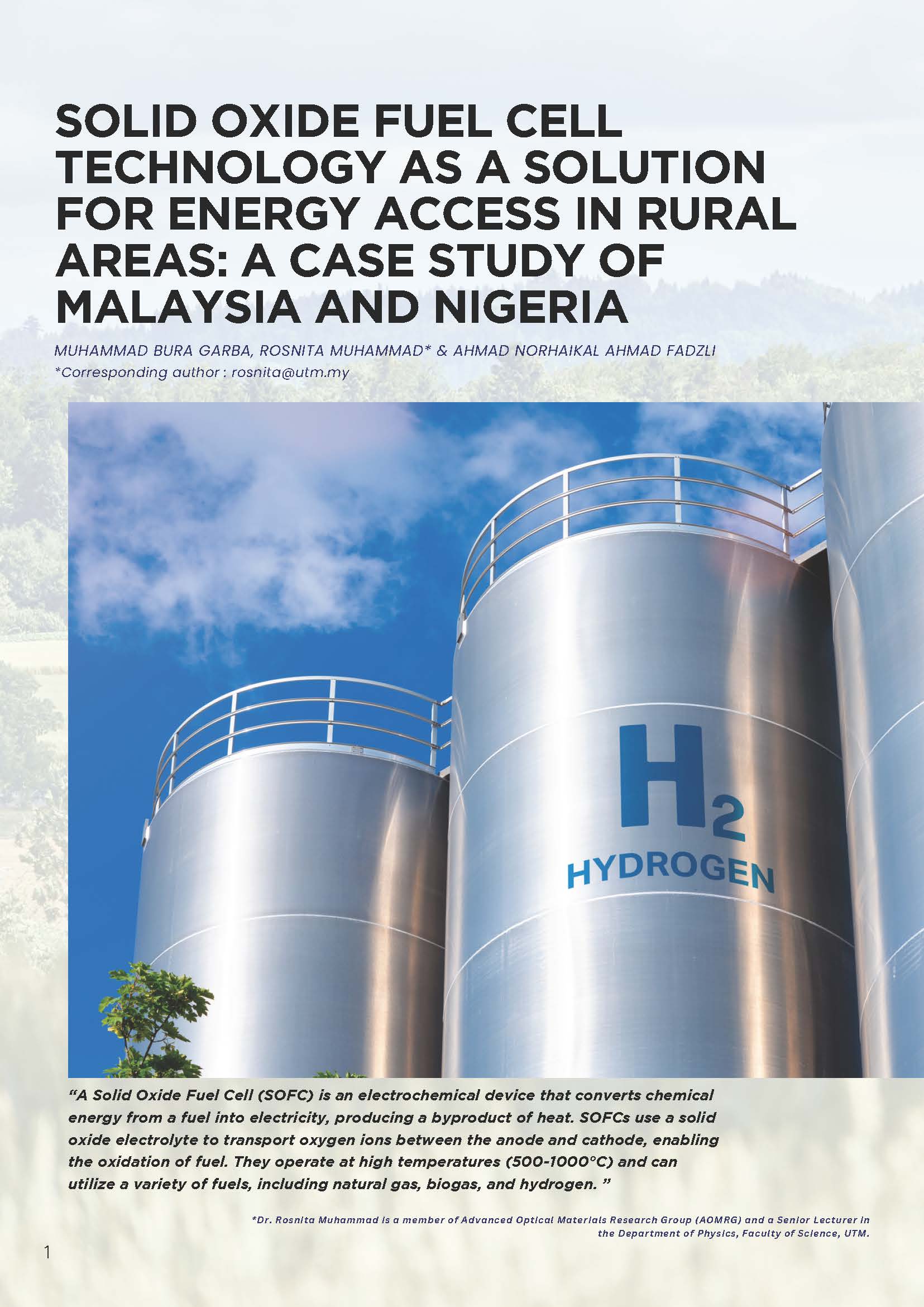
A Solid Oxide Fuel Cell (SOFC) is an electrochemical device that converts chemical energy from a fuel into electricity, producing a byproduct of heat. SOFCs use a solid oxide electrolyte to transport oxygen ions between the anode and cathode, enabling the oxidation of fuel. They operate at high temperatures (500–1000 °C) and can utilize a variety of fuels, including natural gas, biogas, and hydrogen.
Dr. Rosnita Muhammad is a member of the Advanced Optical Materials Research Group (AOMRG) and a Senior Lecturer in the Department of Physics, Faculty of Science, UTM.
Introduction
Access to reliable electricity is a fundamental driver of economic and social development. Yet, millions remain without sufficient energy access, particularly in rural and remote areas. In 2021, the International Energy Agency reported that approximately 770 million people globally still lack access to electricity, a gap in regions like Sub-Saharan Africa and parts of Southeast Asia (Casati et al., 2023). In Malaysia and Nigeria, this energy deficit is especially acute in rural areas, where infrastructure limitations and geographical isolation hinder traditional grid expansion. For these communities, the lack of reliable power disrupts daily life, limiting opportunities for education, healthcare, and economic growth.
The need for resilient, off-grid energy solutions is therefore critical in these regions, with recent attention turning to alternative energy technologies, including Solid Oxide Fuel Cells (SOFCs). Unlike traditional diesel generators, which are costly to maintain and contribute significantly to pollution, SOFCs offer a cleaner, more efficient alternative that can utilize locally available fuels, such as biogas and natural gas. This versatility and adaptability make SOFCs particularly suited to addressing energy access challenges in rural settings (Li et al., 2024).
Malaysia’s energy landscape is marked by stark regional disparities, with urban centers enjoying robust grid connectivity and rural areas, especially those in East Malaysia and on scattered islands, often struggling with limited or inconsistent power supply. The topographical diversity of Malaysia, which includes mountainous regions, tropical rainforests, and an extensive coastline, complicates the development of centralized grid systems. This is particularly true in the states of Sabah and Sarawak on Borneo Island, where dense forests and mountainous terrain limit infrastructure access and where approximately 10% of the population lives without reliable electricity (Jasni et al., 2024).
Malaysia has made strides in renewable energy policies, with targets to achieve 31% renewable energy in the national energy mix by 2025. However, the bulk of these renewable initiatives have focused on urban and peri-urban areas, leaving rural regions underserved (Fernandez et al., 2024). SOFCs present a compelling solution for these regions due to their high efficiency and fuel flexibility, particularly given Malaysia’s rich agricultural sector, which produces considerable amounts of biomass waste. Studies suggest that this agricultural biomass, alongside natural gas from domestic reserves, could serve as a sustainable and locally sourced fuel for SOFC systems, reducing dependency on imported energy sources and enhancing energy security for rural communities.
Deploying SOFCs in Malaysian rural areas could provide a two-fold benefit: addressing energy access gaps and promoting local economic activity through biofuel production. Additionally, SOFCs’ ability to generate heat alongside electricity can support agricultural and small-scale industrial activities, which are central to rural livelihoods. However, high initial costs, lack of technical expertise, and limited awareness among rural populations remain significant barriers to SOFC adoption. Government support, including subsidies or incentives for biofuel integration, as well as training programs, will be greatly helpful for scaling SOFC technology in Malaysia (Zakaria and Kamarudin, 2021).
Nigeria faces one of the largest energy access deficits globally, with nearly 85 million Nigerians, about 40% of the population, lacking reliable access to electricity, most of whom live in rural areas (Monyei et al., 2018). Infrastructure challenges, including an aging and overstressed grid, frequent blackouts, and inadequate investments in rural electrification exacerbate this energy gap. Nigeria’s rural areas are often isolated and difficult to access, which makes grid extension costly and complex. Moreover, the high reliance on diesel generators in off-grid communities is unsustainable due to high fuel costs, environmental impact, and supply disruptions.
Despite these challenges, Nigeria is endowed with abundant natural gas reserves, ranking as one of the largest producers in Africa. This natural gas, if harnessed effectively, could serve as a reliable fuel source for SOFCs, offering a more sustainable alternative to diesel. Additionally, Nigeria’s agricultural sector produces significant amounts of organic waste that could be converted into biogas, further diversifying the potential fuel options for SOFC systems (Salami et al., 2021). With these resources, SOFC technology could play a transformative role in addressing Nigeria’s rural energy needs, providing a decentralized solution that minimizes reliance on the national grid.
However, the adoption of SOFCs in Nigeria faces distinct barriers. Limited awareness and understanding of fuel cell technology, coupled with high initial capital costs, present significant challenges (Bello et al., 2025). The Nigerian government’s recent Renewable Energy Master Plan includes targets for rural electrification, but policy support and financial mechanisms specifically favoring fuel cell adoption are currently limited. Moreover, technical skills for operating and maintaining SOFCs are scarce in rural regions, necessitating capacity-building initiatives and partnerships with private sector players to ensure successful deployment.
This study explores the feasibility and impact of using SOFC technology for rural electrification in Malaysia and Nigeria, two countries with different energy landscapes yet similar rural energy challenges. Malaysia’s varied geography and reliance on biomass waste present unique opportunities for biofuel-powered SOFC systems, while Nigeria’s abundant natural gas and high energy deficit make SOFCs a potentially scalable solution to address off-grid needs. Through a comparative approach, this study aims to provide insights into the conditions under which SOFCs can be effectively implemented and sustained in these rural settings.
Overview of Solid Oxide Fuel Cell (SOFC) Technology
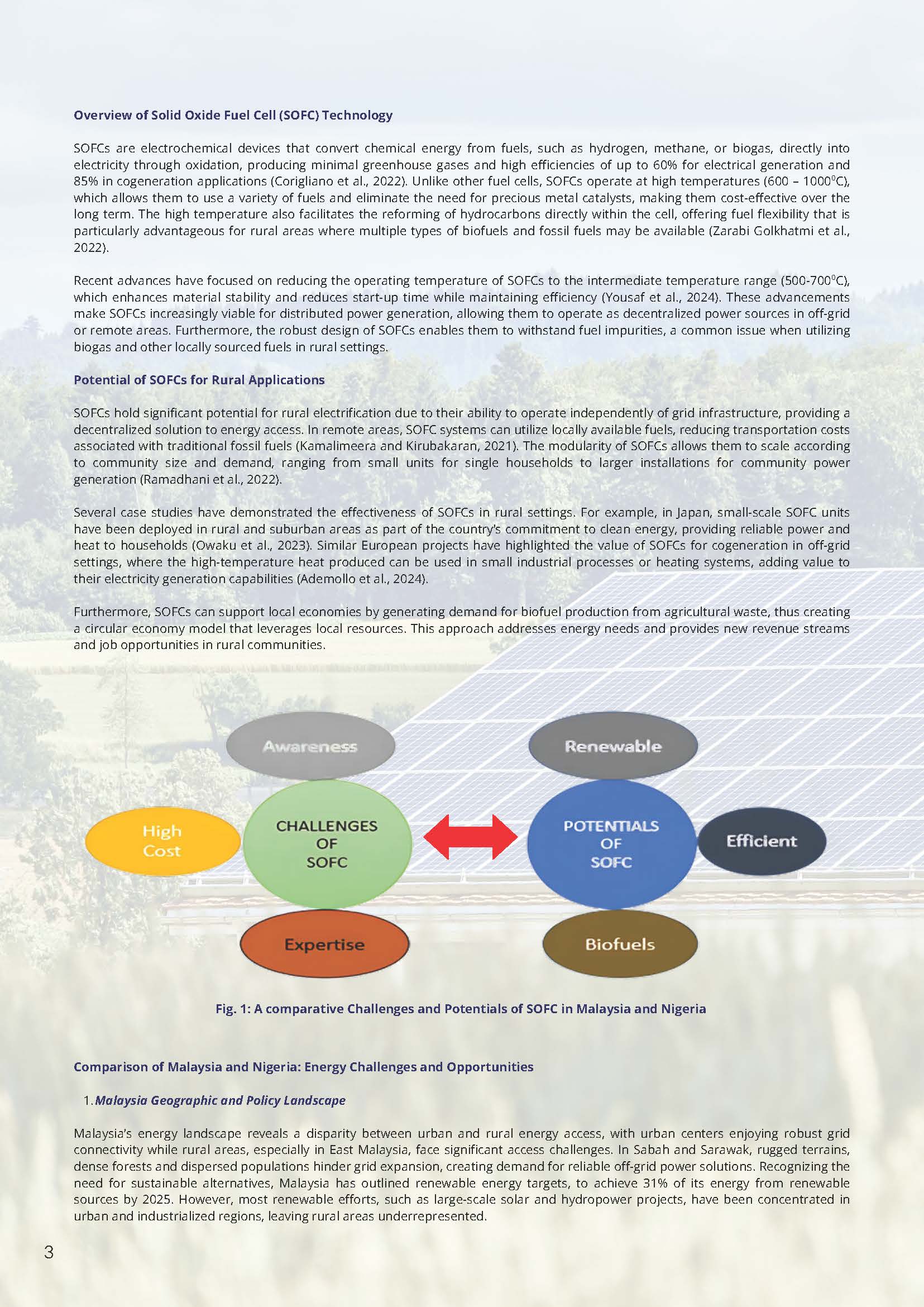
SOFCs are electrochemical devices that convert chemical energy from fuels, such as hydrogen, methane, or biogas, directly into electricity through oxidation, producing minimal greenhouse gases and high efficiencies of up to 60% for electrical generation and 85% in cogeneration applications (Corigliano et al., 2022). Unlike other fuel cells, SOFCs operate at high temperatures (600–1000 °C), which allows them to use a variety of fuels and eliminates the need for precious metal catalysts, making them cost-effective over the long term. The high temperature also facilitates the reforming of hydrocarbons directly within the cell, offering fuel flexibility that is particularly advantageous for rural areas where multiple types of biofuels and fossil fuels may be available (Zarabi Golkhatmi et al., 2022).
Recent advances have focused on reducing the operating temperature of SOFCs to the intermediate temperature range (500–700 °C), which enhances material stability and reduces start-up time while maintaining efficiency (Yousaf et al., 2024). These advancements make SOFCs increasingly viable for distributed power generation, allowing them to operate as decentralized power sources in off-grid or remote areas. Furthermore, the robust design of SOFCs enables them to withstand fuel impurities, a common issue when utilizing biogas and other locally sourced fuels in rural settings.
Potential of SOFCs for Rural Applications
SOFCs hold significant potential for rural electrification due to their ability to operate independently of grid infrastructure, providing a decentralized solution to energy access. In remote areas, SOFC systems can utilize locally available fuels, reducing transportation costs associated with traditional fossil fuels (Kamalimeera and Kirubakaran, 2021). The modularity of SOFCs allows them to scale according to community size and demand, ranging from small units for single households to larger installations for community power generation (Ramadhani et al., 2022).
Several case studies have demonstrated the effectiveness of SOFCs in rural settings. For example, in Japan, small-scale SOFC units have been deployed in rural and suburban areas as part of the country’s commitment to clean energy, providing reliable power and heat to households (Owaku et al., 2023). Similar European projects have highlighted the value of SOFCs in cogeneration in off-grid settings, where the high-temperature heat produced can be used in small industrial processes or heating systems, adding value to their electricity generation capabilities (Ademollo et al., 2024).
Furthermore, SOFCs can support local economies by generating demand for biofuel production from agricultural waste, thus creating a circular economy model that leverages local resources. This approach addresses energy needs and provides new revenue streams and job opportunities in rural communities.
Comparison of Malaysia and Nigeria: Energy Challenges and Opportunities
1. Malaysia: Geographic and Policy Landscape
Malaysia’s energy landscape reveals a disparity between urban and rural energy access, with urban centers enjoying robust grid connectivity while rural areas, especially in East Malaysia, face significant access challenges. In Sabah and Sarawak, rugged terrains, dense forests, and dispersed populations hinder grid expansion, creating demand for reliable off-grid power solutions. Recognizing the need for sustainable alternatives, Malaysia has outlined renewable energy targets, to achieve 31% of its energy from renewable sources by 2025. However, most renewable efforts, such as large-scale solar and hydropower projects, have been concentrated in urban and industrialized regions, leaving rural areas underrepresented.
In these rural areas, SOFC technology can address multiple needs. Malaysia’s significant biomass resources, derived from its agricultural industry, offer abundant, renewable fuel sources for SOFCs, particularly in off-grid settings. The adoption of SOFCs aligns with Malaysia’s policy direction on renewable energy while offering a practical solution for rural communities that lack access to stable grid power. However, challenges remain, as mentioned earlier, such as high upfront costs and limited local expertise in fuel cell technology, requiring targeted government support and community-based training to facilitate deployment (Zakaria et al., 2021).
2. Nigeria: Resource Abundance and Infrastructure Challenges
The country’s aging grid infrastructure, frequent blackouts, and limited investments in rural electrification exacerbate these access issues. Furthermore, diesel-based power generation is prevalent but unsustainable due to high fuel costs and environmental impacts. Despite these challenges, Nigeria possesses abundant natural gas reserves, offering a readily available and cleaner fuel option for SOFC deployment (Ezechi and Ndulue, 2022).
SOFCs, powered by locally sourced natural gas or agricultural waste-derived biogas, could provide a stable and cost-effective energy solution for Nigeria’s rural communities, addressing both electricity and cooking fuel needs. However, the adoption of SOFC technology in Nigeria faces specific barriers, including a lack of skilled technicians and limited government policies supporting fuel cell technology, as mentioned in Table 1. To overcome these challenges, strategic partnerships between the government, private sector, and international stakeholders are essential for building local capacity and securing investment in SOFC infrastructure (Oladigbolu et al., 2020).
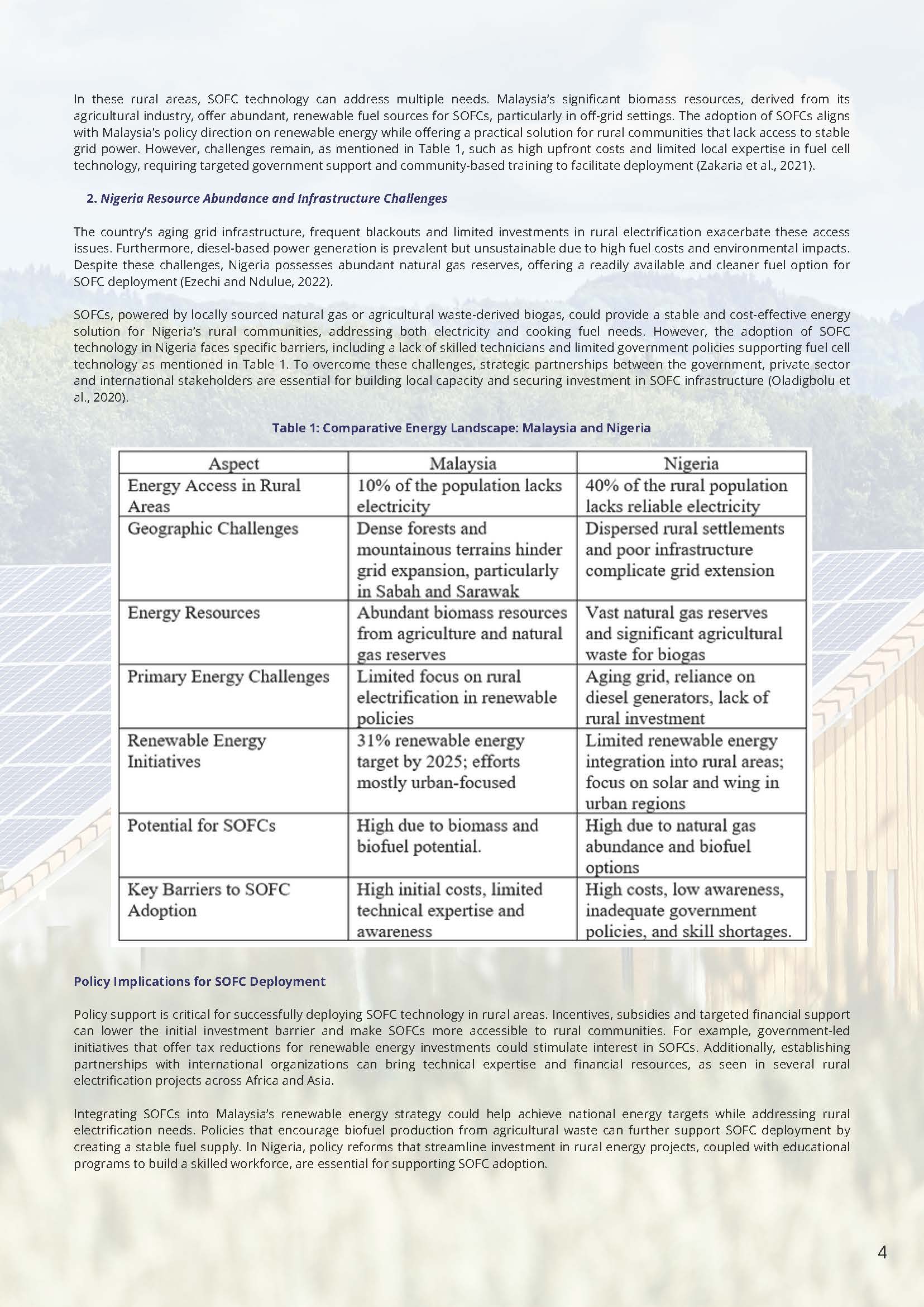
Table 1: Comparative Energy Landscape – Malaysia and Nigeria
Energy Access in Rural Areas
Malaysia: 10% of the population lacks electricity
Nigeria: 40% of the rural population lacks reliable electricity
Geographic Challenges
Malaysia: Dense forests and mountainous terrains hinder grid expansion, particularly in Sabah and Sarawak
Nigeria: Dispersed rural settlements and poor infrastructure complicate grid extension
Energy Resources
Malaysia: Abundant biomass resources from agriculture and natural gas reserves
Nigeria: Vast natural gas reserves and significant agricultural waste for biogas
Primary Energy Challenges
Malaysia: Limited focus on rural electrification in renewable policies
Nigeria: Aging grid, reliance on diesel generators, lack of rural investment
Renewable Energy Initiatives
Malaysia: 31% renewable energy target by 2025; efforts mostly urban-focused
Nigeria: Limited renewable energy integration into rural areas; focus on solar and wind in urban regions
Potential for SOFCs
Malaysia: High due to biomass and biofuel potential
Nigeria: High due to natural gas abundance and biofuel options
Key Barriers to SOFC Adoption
Malaysia: High initial costs, limited technical expertise and awareness
Nigeria: High costs, low awareness, inadequate government policies, and skill shortages
Policy Implications for SOFC Deployment
Policy support is critical for successfully deploying SOFC technology in rural areas. Incentives, subsidies, and targeted financial support can lower the initial investment barrier and make SOFCs more accessible to rural communities. For example, government-led initiatives that offer tax reductions for renewable energy investments could stimulate interest in SOFCs. Additionally, establishing partnerships with international organizations can bring technical expertise and financial resources, as seen in several rural electrification projects across Africa and Asia.
Integrating SOFCs into Malaysia’s renewable energy strategy could help achieve national energy targets while addressing rural electrification needs. Policies that encourage biofuel production from agricultural waste can further support SOFC deployment by creating a stable fuel supply. In Nigeria, policy reforms that streamline investment in rural energy projects, coupled with educational programs to build a skilled workforce, are essential for supporting SOFC adoption.
Conclusion
The literature underscores the promising role of SOFCs in rural electrification, particularly in resource-abundant regions like Malaysia and Nigeria. While SOFC technology offers many advantages for rural energy access, successful implementation in these diverse contexts requires tailored approaches that consider local fuel availability, infrastructure, and policy support. Malaysia’s biomass resources and Nigeria’s natural gas reserves create unique opportunities for sustainable fuel use, but both countries must address technical, financial, and policy barriers to enable widespread SOFC adoption. By establishing supportive frameworks and leveraging local resources, Malaysia and Nigeria can make strides toward bridging the rural energy gap with SOFC technology.
References
Ademollo, A., Mati, A., Pagliai, M., Carcasci, C. (2024). Clean Production, 469, 143254.
Bello, I.T., Jolaoso, L.A., Ahmed, R.A., Bello, A. (2025). Energy Reviews, 4, 100109.
Casati, P., Moner-Girona, M., Khaleel, S., Szabo, S., Nhamo, G. (2023). Energy for Sustainable Development, 72, 114–126.
Corigliano, O., Pagnotta, L., Fragiacomo, P. (2022). Sustainability, 14, 15276.
Ezechi, N., Ndulue, C. (2022). Flare Gas to Energy Using Hydrogen Fuel Cell Solid Oxide Fuel Cells: The Nigerian Perspective, SPE.
Fernandez, M.I., Go, Y.L., Wong, M.L.D., Früh, W.-G. (2024). Renewable Energy Focus, 51, 100640.
Jasni, A.S., Saverinus, B., Abdul Wahab, Z., Tze Ding, L., Parman, R.P., Mohd Razali, S., Jamaluddin, J., Abu Bakar, S.N., Abdul Hamid, H., Kamarudin, W. (2024). Pertanika Journal of Science & Technology, 32, 63–75.
Kamalimeera, N., Kirubakaran, V. (2021). Renewable and Sustainable Energy Reviews, 143, 110914.
Li, J., Cheng, J., Zhang, Y., Chen, Z., Nasr, M., Farghali, M., Rooney, D.W., Yap, P., Osman, A.I. (2024). Advanced Energy and Sustainability Research, 5.
Monyei, C.G., Adewumi, A.O., Obolo, M.O., Sajou, B. (2018). Renewable and Sustainable Energy Reviews, 81, 1582–1601.
Oladigbolu, J.O., Ramli, M.A.M., Al-Turki, Y.A. (2020). IEEE Access, 8, 171643–171663.
Owaku, T., Yamamoto, H., Akisawa, A. (2023). Energies, 16, 2236.
Ramadhani, F., Hussain, M.A., Mokhlis, H., Erxino, D. (2022). Processes, 10, 2126.
Salami, H.A., Lawal, S.O., Bademosi, T., Olowosokede, O., Olalekan, H.I. (2021). Journal of Fundamental and Applied Sciences, 13, 1411–1446.
Yousaf, M., Lu, Y., Akbar, M., Lei, L., Jing, S., Tao, Y. (2024). Materials Today Energy, 44, 101633.
Zakaria, Z., Kamarudin, S.K. (2021). International Journal of Energy Research, 45, 4871–4887.
Zakaria, Z., Kamarudin, S.K., Abd Wahid, K.A., Abu Hassan, S.H. (2021). Renewable and Sustainable Energy Reviews, 144, 110984.
Zarabi Golkhatmi, S., Asghar, M.I., Lund, P.D. (2022). Renewable and Sustainable Energy Reviews, 161, 112339.