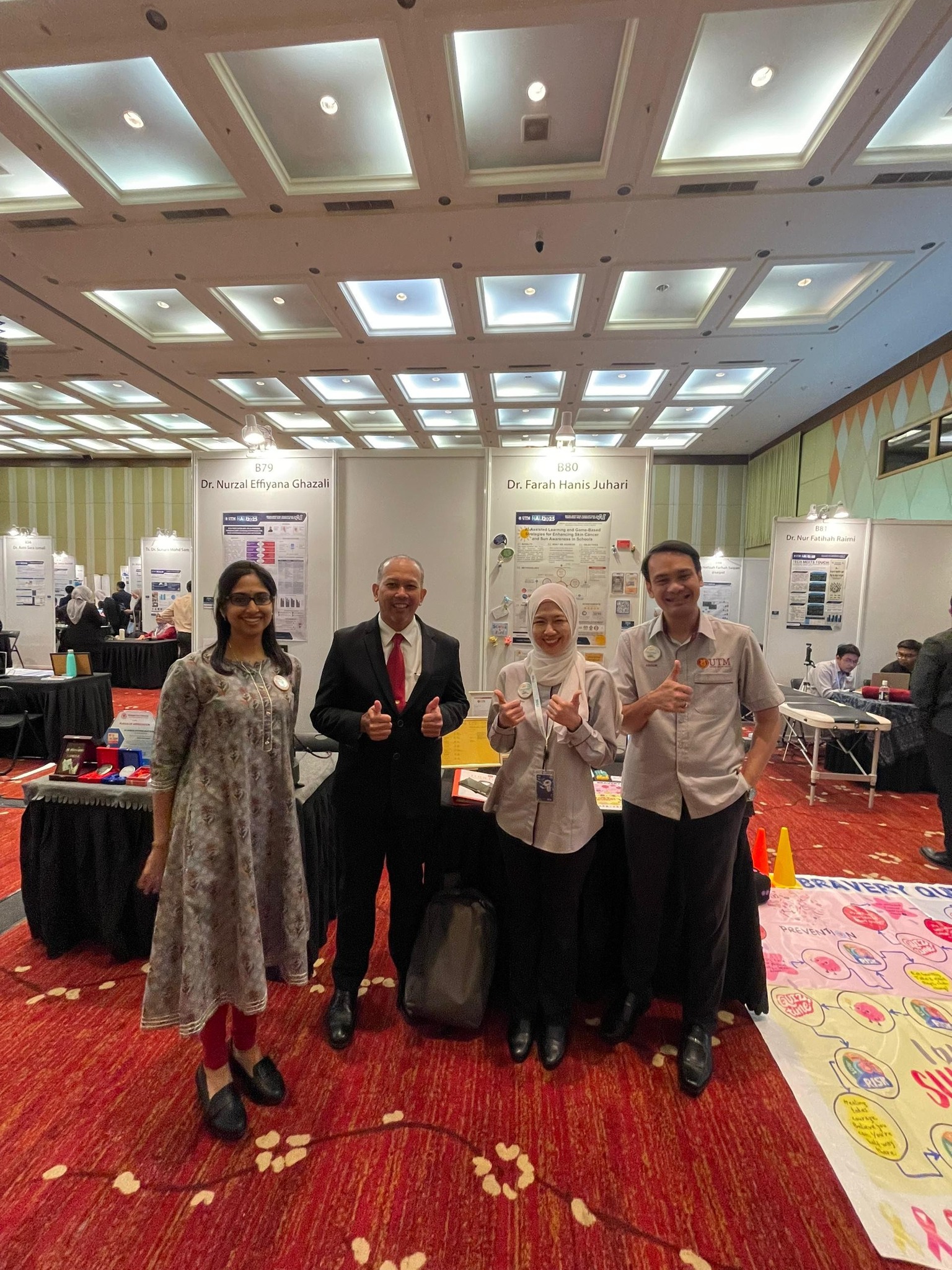
In an inspiring effort to promote public health and scientific literacy, researchers from the Cancer and Infectious Diseases Research Group (CAID), Faculty of Science, Universiti Teknologi Malaysia (UTM) have developed an innovative AI-assisted learning and game-based program to raise awareness about skin cancer and sun protection among secondary school students
Led by Dr. Farah Hanis Juhari with co-researchers Dr. Khairunadwa Jemon, Dr. Nurriza Ab. Latif, Dr. Mohd Aizuddin Mohd Lazaldin, Dr. Praseetha Prabhakaran, Dr. Wan Fatin Amira Wan Mohd Zawawi, Dr. Nurzila Ab. Latif, Dr. Saleha Shahar, and Dr. Mohd Helmi Sani, the project successfully combined AI-powered content creation, hands-on STEM learning, and a custom-designed educational board game to deliver health education in a creative and impactful way.
Bringing Science and Health Awareness to Life
The project, titled “AI-Assisted Learning and Game-Based Strategies for Enhancing Skin Cancer and Sun Awareness in Schools,” integrates New Academia Learning Innovation (NALI) principles such as student-centered learning, authentic assessment, edutainment, and service learning.
Through this approach, students from SMK Damai Jaya, SMK Mutiara Rini, and SMK Sultan Ismail explored real-world health challenges linked to ultraviolet (UV) exposure, while developing digital literacy and communication skills.
CAID experts introduced participants to the fundamentals of skin anatomy, UV radiation, and sun safety through infographic sessions, hands-on experiments using UV-sensitive beads, and the creation of Play-Doh skin models to visualize the effects of sunlight on human tissue
Innovation Through AI and Game-Based Learning
A central feature of the initiative was the use of Artificial Intelligence tools such as ChatGPT, Canva AI, and CapCut in the development of student-produced awareness videos. These short videos—focused on skin protection, cancer prevention, and sunscreen use—were showcased on CAID’s official Instagram page, promoting peer-to-peer learning and digital health communication.
Another creative highlight was the introduction of the “Bravery Quest” board game, a gamified learning platform that simulates real-life decision-making on sun exposure and skin health. The game uses challenge and reward mechanics to teach students about the risks of unprotected UV exposure and the benefits of preventive actions such as sunscreen use and regular skin checks
Transformative Educational Impact
The project demonstrated remarkable results in improving students’ knowledge, behavior, and attitudes toward skin health.
- Post-program assessments revealed an increase in accurate knowledge from 37.5% to 84%.
- All participants were able to identify key skin cancer risk factors and the importance of sunscreen use.
- Interest in biology as a subject rose by 35%, with students showing higher engagement and appreciation for science in everyday life.
Social media analytics also reflected strong outreach impact — videos produced under the initiative recorded over 1,000 views and hundreds of engagements, proving the effectiveness of AI-integrated education in reaching a wider audience
National Recognition and Community Collaboration
The project received the 5-Star Community Project Rating (2024) and was featured in The Star newspaper on 29 October 2024 for its innovative approach to youth science engagement.
Supported by KTP@Faculty 2024 through UTM’s Centre for Community and Industry Network (CCIN), the program was conducted in collaboration with the Johor Bahru District Health Office (PKDJB), Johor State Education Department (JPNJ), SMK Damai Jaya, SMK Mutiara Rini, SMK Sultan Ismail, and Skinlab Biochem Resources (M) Sdn. Bhd.
Dr. Farah Hanis highlighted the broader vision of the project:
“This initiative shows how AI, STEM, and game-based learning can come together to create meaningful impact — empowering students as health ambassadors while rekindling their love for science.”
📍 Project Title: AI-Assisted Learning and Game-Based Strategies for Enhancing Skin Cancer and Sun Awareness in Schools
👩🏫 Principal Investigator: Dr. Farah Hanis Juhari, Department of Biosciences, Faculty of Science, UTM
📧 Contact: farahhanis@utm.my