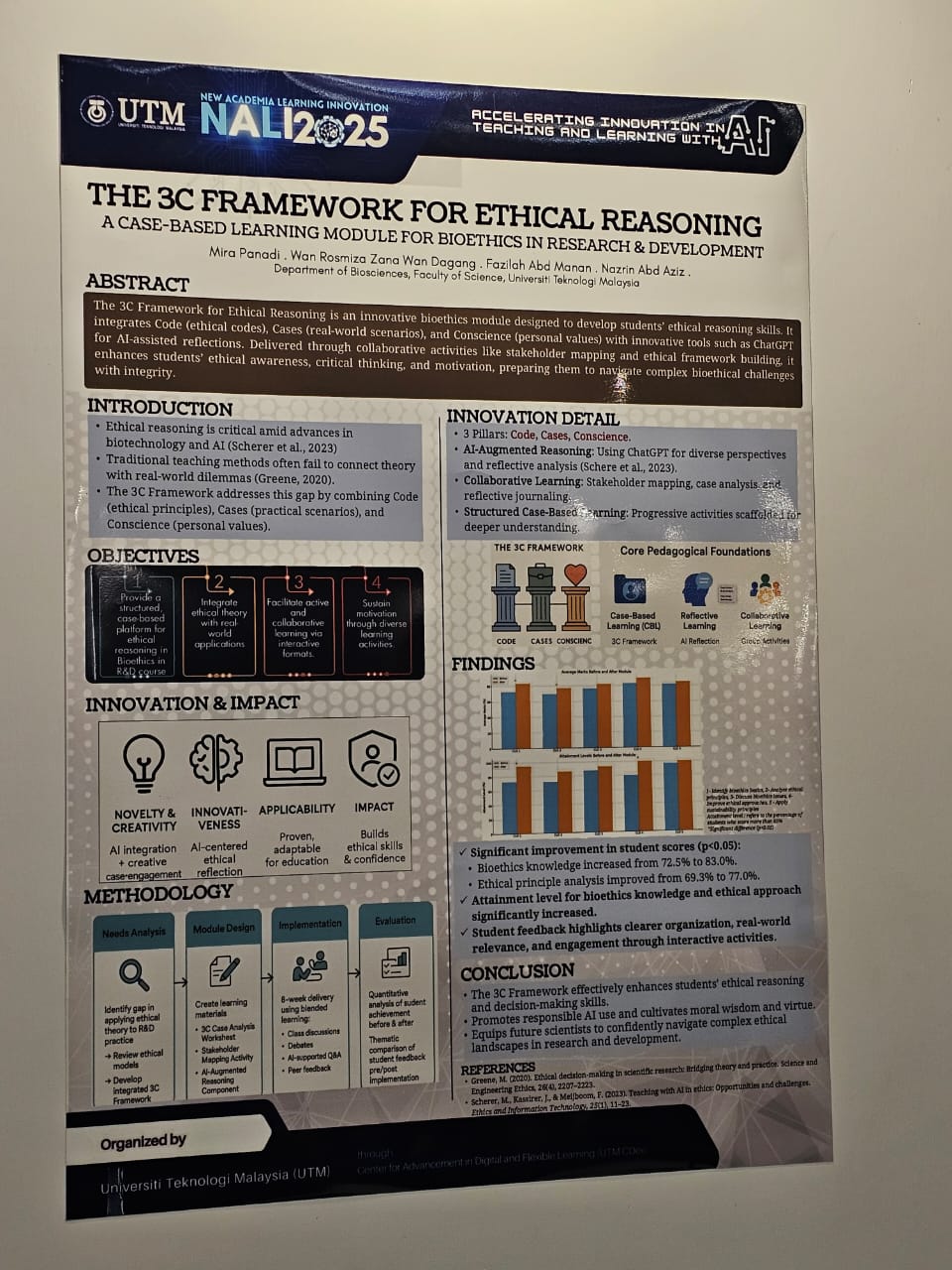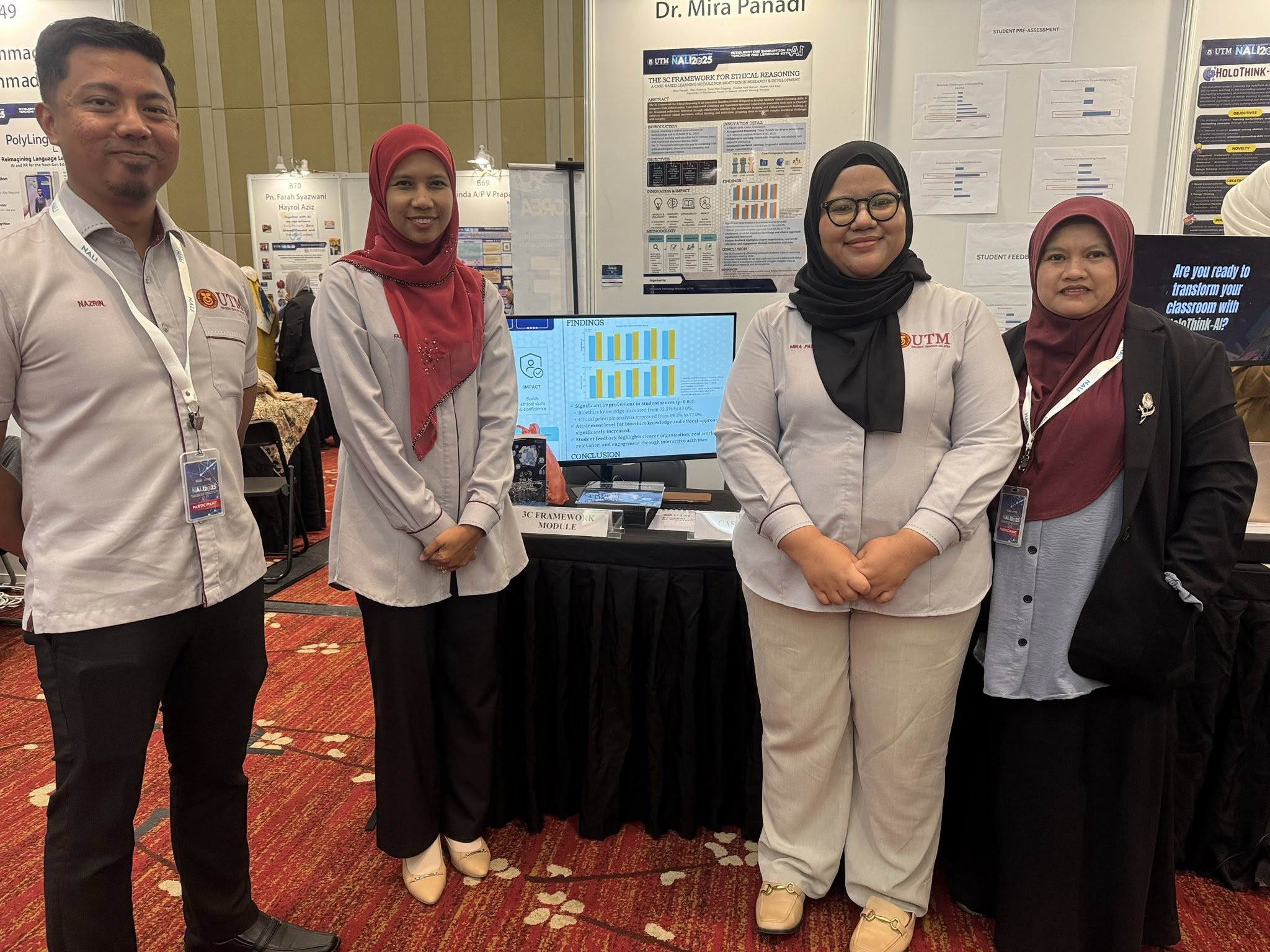
The Department of Biosciences, Faculty of Science, Universiti Teknologi Malaysia (UTM) has introduced an innovative approach to bioethics education through the development of the 3C Framework for Ethical Reasoning, a module designed to strengthen ethical decision-making and digital literacy among future scientists
Spearheaded by Dr. Mira Panadi, with co-researchers Dr. Wan Rosmiza Zana Wan Dagang, Dr. Fazilah Abd Manan, and Dr. Nazrin Abd Aziz, the project combines ethical theory, real-world cases, and personal conscience into a structured framework enhanced by Artificial Intelligence (AI) tools such as ChatGPT. This pioneering integration supports UTM’s New Academia Learning Innovation (NALI) agenda, promoting student-centered, technology-augmented learning that develops both professional integrity and digital competence.
A Structured Pathway to Ethical Reasoning
The 3C Framework is built around three pillars — Code, Cases, and Conscience — forming a practical guide for students to analyze ethical dilemmas commonly faced in scientific research and development.
“Our goal is to move beyond memorization of ethical principles. The 3C Framework helps students think ethically, not just learn ethics,” explained Dr. Mira.
Through structured worksheets, stakeholder mapping, and guided reflections, students engage in case-based learning that transforms abstract concepts into real-world applications. The use of AI in classroom discussions enables students to critically evaluate AI-generated responses, deepening their ethical reasoning while cultivating responsible digital citizenship.
AI-Enhanced and Collaborative Learning
Unlike conventional lectures, the 3C module emphasizes active learning and collaboration. Students analyze real research ethics cases—ranging from AI in medical research to data privacy and vaccine equity—while using AI tools to explore multiple perspectives.
The introduction of the “AI Response Reflection” worksheet marks a key innovation: students must critique, refine, and reflect on the ethical soundness of AI-generated suggestions. This unique approach enhances critical thinking, ethical sensitivity, and digital fluency, preparing students to responsibly navigate AI-integrated research environments.
Transformative Impact on Student Learning
Quantitative and qualitative analyses show significant improvements in student performance and engagement:
- Knowledge of bioethics principles increased from 72.5% to 83%,
- Application and analysis of ethical principles rose from 69.3% to 77%,
- Attainment levels in recognizing ethical improvements to environment and professional practice climbed from 80% to 100%
Students also reported higher motivation, appreciation for real-world relevance, and confidence in applying ethics to research practice. Feedback highlighted that the combination of structured learning, AI engagement, and visual activities such as poster presentations made the module both interactive and intellectually stimulating.
Recognizing Innovation in Bioethics Education
The 3C Framework represents a major pedagogical advancement in bioethics education and has been submitted for copyright registration (Reference No: IP/CR/07794).
It stands as a model of how AI-augmented learning can cultivate ethical reasoning, integrity, and moral responsibility — skills essential for researchers in biotechnology, health sciences, and emerging interdisciplinary fields.
“As we enter an era where science and AI intersect, ethical reasoning must evolve too. This framework helps ensure our future scientists act with conscience and integrity,” Dr. Mira added.
📍 Project Title: The 3C Framework for Ethical Reasoning: A Case-Based Learning Module for Bioethics in Research and Development
👩🏫 Principal Investigator: Dr. Mira Panadi, Department of Biosciences, Faculty of Science, UTM
📧 Contact: mirapanadi@utm.my
🔗 Discover more research and educational innovations at: https://science.utm.my/utmfsresearch/