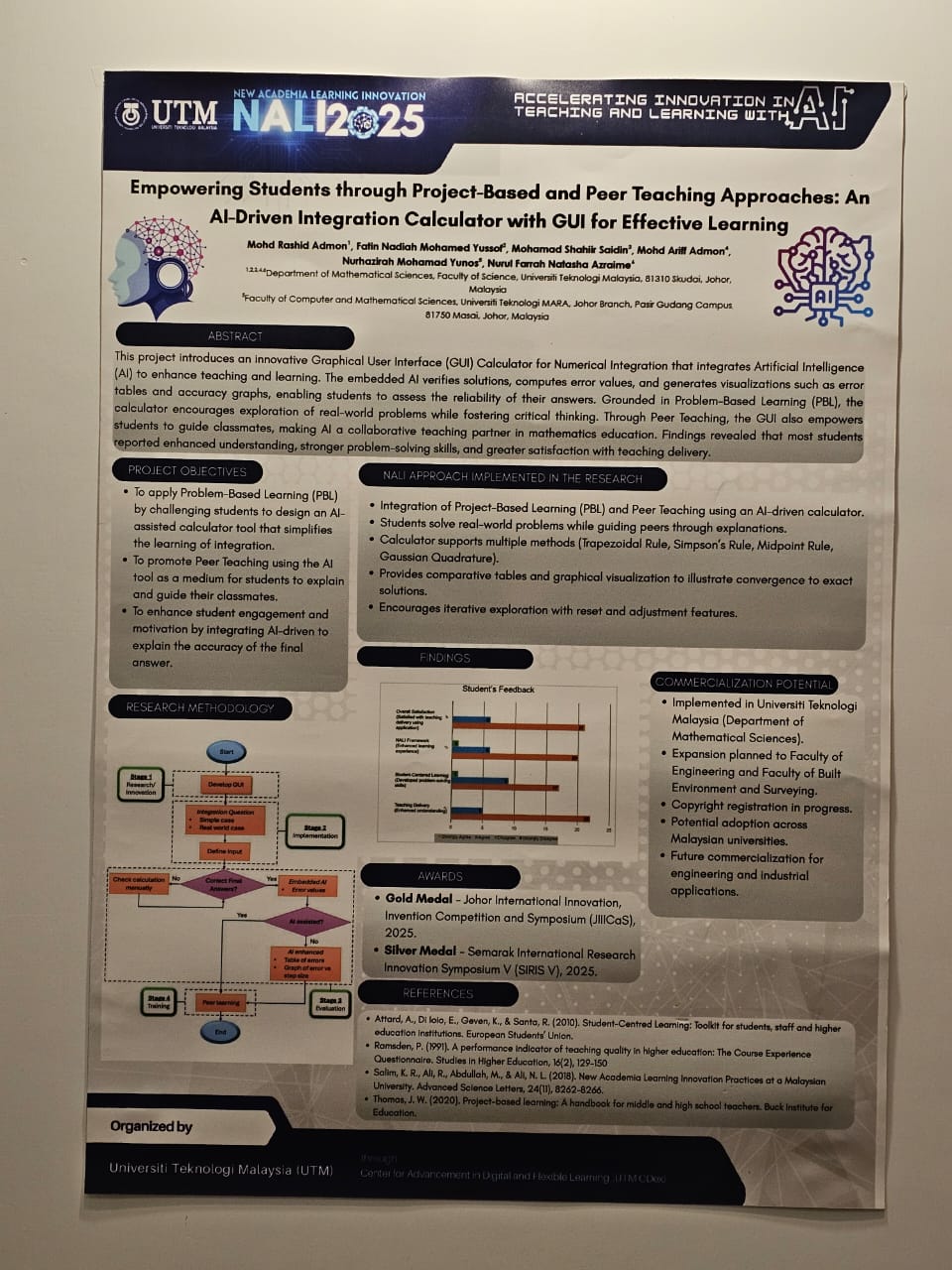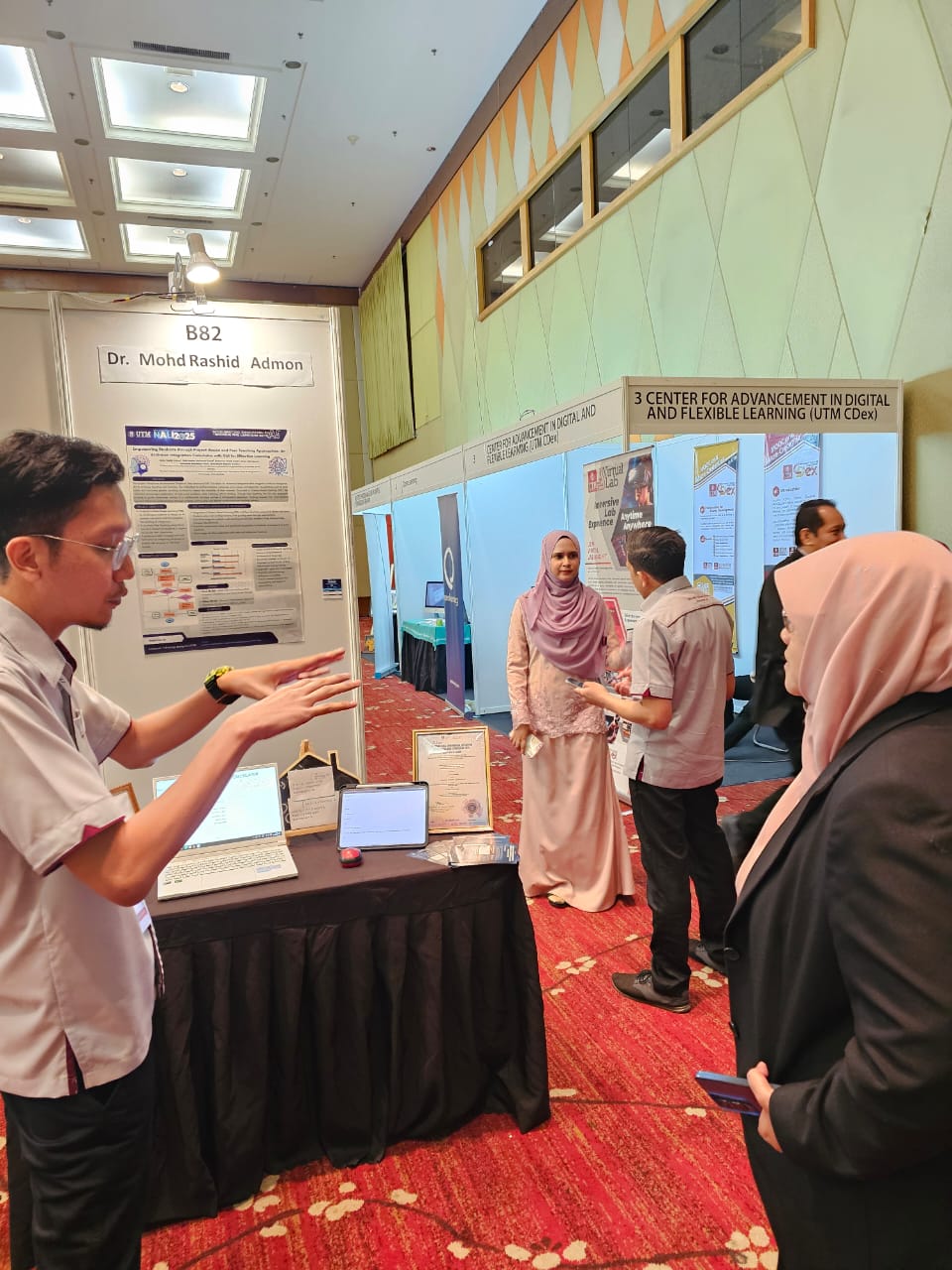
A team of researchers from the Department of Mathematical Sciences, Faculty of Science, Universiti Teknologi Malaysia (UTM) has successfully developed an innovative AI-driven Graphical User Interface (GUI) Integration Calculator, marking a breakthrough in the teaching and learning of numerical methods.
Led by Dr. Mohd Rashid Admon, together with Fatin Nadiah Mohamed Yussof, Mohamad Shahiir Saidin, Mohd Ariff Admon, Nurhazirah Mohamad Yunos, and Nurul Farrah Natasha Azraime, the project introduces a new way of learning numerical integration through Artificial Intelligence (AI), Problem-Based Learning (PBL), and Peer Teaching.
AI-Powered Learning in Mathematics
The developed calculator integrates several numerical methods — including Trapezoidal Rule, Simpson’s Rule, Romberg Integration, and Gaussian Quadrature — allowing students to explore and compare various computational techniques. Through its interactive interface, users can input functions, intervals, and step sizes, while the embedded AI verifies answers, calculates error values, and visualizes results in tables and graphs.
This approach not only simplifies complex computations but also transforms the learning process into an engaging, visual, and reflective experience. “Students can now see how their methods converge to the actual solution while identifying the accuracy of each technique,” said Dr. Rashid.
Bridging Theory and Real-World Applications
Beyond classroom exercises, the AI-driven tool demonstrates strong potential for real engineering applications, such as structural load analysis, fluid flow estimation, and energy computation. This bridges the gap between abstract mathematical formulas and practical problem-solving scenarios.
Through Problem-Based Learning (PBL), students are challenged to identify real-world problems, design their own GUIs, and embed AI modules to test and analyze results. Meanwhile, Peer Teaching promotes collaboration as students guide one another through the integration processes, reinforcing understanding and communication skills.
A New Pedagogical Framework for Numerical Methods
The learning framework was implemented in the Numerical Methods (SSCE2793) course, where students participated in a structured four-stage process — Research/Innovation, Implementation, Evaluation, and Training. Each stage emphasizes creativity, critical thinking, and continuous reflection.
This innovative approach aligns with UTM’s New Academia Learning Innovation (NALI) framework, showcasing how technology and pedagogy can merge to empower students as active creators of knowledge rather than passive learners.
Positive Learning Outcomes
Preliminary feedback from participating students indicated improved comprehension, stronger analytical skills, and higher motivation to engage in mathematics-based problem-solving. The project highlights the transformative role of AI in education — not merely as a computational tool but as a collaborative learning partner.
“By integrating AI into mathematical learning, we’re not only improving accuracy and engagement but also preparing students for the digital future of engineering and data science,” added Dr. Rashid.
📍 Project Title: Empowering Students through Project-Based and Peer Teaching Approaches: An AI-Driven Integration Calculator with GUI for Effective Learning
👨🏫 Principal Investigator: Dr. Mohd Rashid Admon, Department of Mathematical Sciences, Faculty of Science, UTM
📧 Contact: m.rashid@utm.my