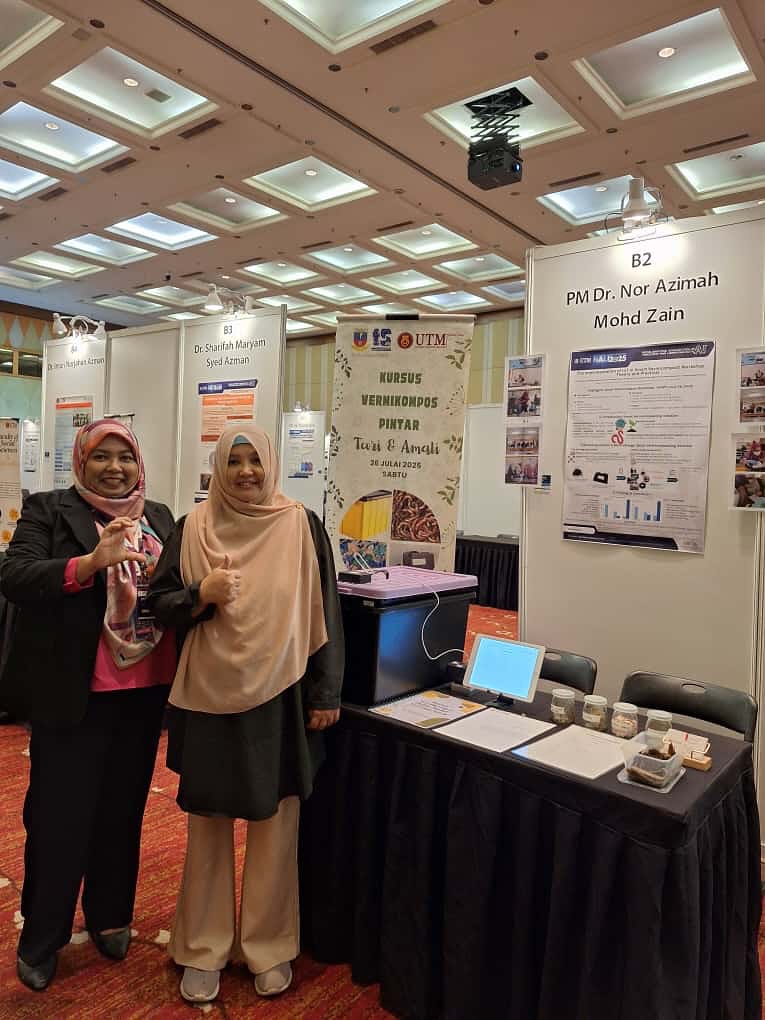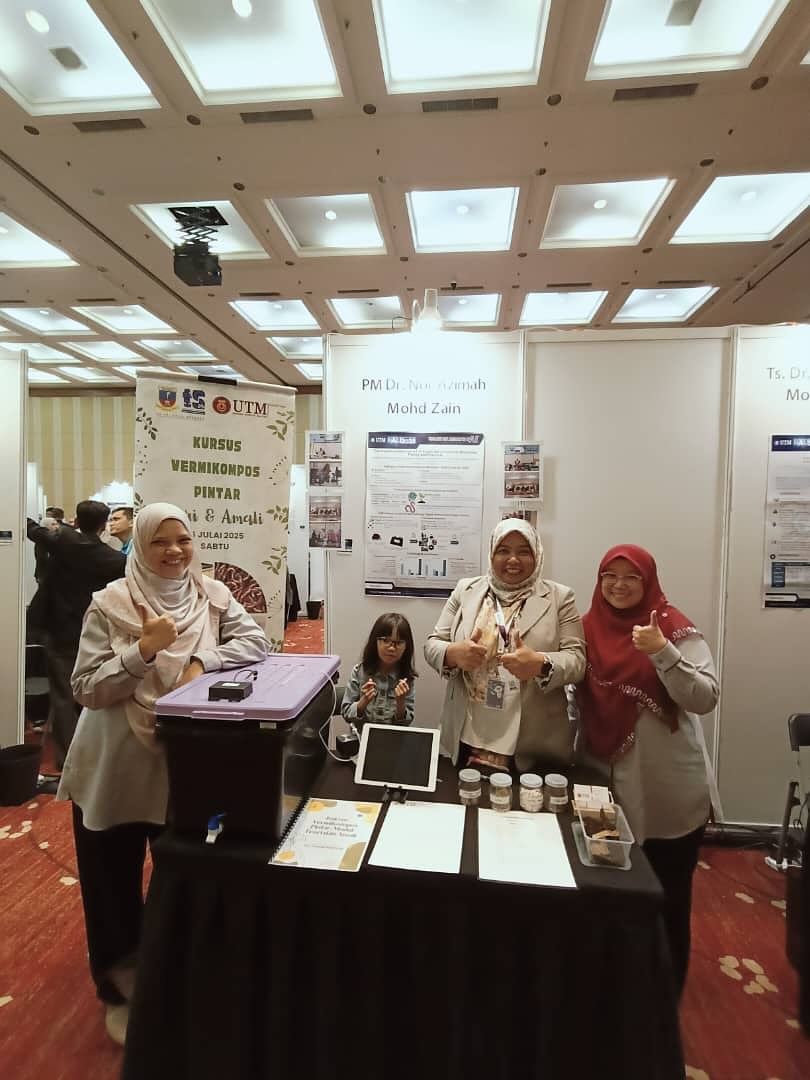
The Department of Biosciences, Faculty of Science, Universiti Teknologi Malaysia (UTM), recently organized a Smart Vermicompost Workshop: Theory and Practical at Sekolah Kebangsaan Sri Pulai Perdana (SKSPP), introducing participants to sustainable organic waste management enhanced by smart technology
Led by Dr. Nor Azimah Mohd Zain and her research team — Dr. Zarita Zakaria, Dr. Siti Halimah Hasmoni, Dr. Nurliyana Ahmad Zawawi, Dr. Nurzila Ab. Latif, Dr. Nurashikin Ihsan, and Dr. Mohd Farizal Ahmad Kamaroddin — the workshop combined environmental education with technological empowerment, marking another successful step in UTM’s effort to promote community-based sustainability and digital transformation.
Integrating Science, Technology, and Community Learning
The workshop, attended by 10 participants from the Persatuan Ibu Bapa dan Guru (PIBG) of SKSPP, introduced the science and technology behind vermicomposting, a natural process using earthworms (Eudrilus eugeniae) to convert organic waste into nutrient-rich compost.
Participants explored two core learning components:
- Theoretical session on vermicomposting science, worm biology, and the role of organic waste recycling.
- Hands-on session where participants built their own smart vermicompost box equipped with the EcoGold Smart Monitoring System — an Internet of Things (IoT) device designed to monitor temperature and moisture levels in real-time
This practical integration of IoT with sustainability empowers participants to effectively manage waste while producing high-quality compost at home, aligning with UTM’s mission to merge STEM education with environmental stewardship.
“We wanted to show that sustainability can go hand in hand with innovation. By integrating IoT monitoring, participants can manage their compost scientifically and efficiently,” said Dr. Nor Azimah.
Empowering Communities with Smart Sustainability Skills
A pre- and post-survey was conducted to assess the workshop’s impact. Results showed a significant improvement in participants’ understanding of both vermicomposting and IoT applications in agriculture:
- Before the workshop, most participants reported limited familiarity with composting science and digital monitoring.
- After the session, nearly 80% strongly agreed that they understood how smart devices like EcoGold could optimize the composting process.
This finding underscores the effectiveness of community-based learning programs that combine hands-on experimentation with technology-driven insights.
“Before this, I didn’t realize how sensors could help in composting. Now I understand how to maintain the best conditions for the worms,” shared one participant from SKSPP’s PIBG.
Sustainable Impact and Future Prospects
The workshop’s outcomes demonstrate that integrating IoT technology into environmental education can strengthen both scientific literacy and community engagement. By equipping participants with knowledge and tools for real-world application, the program encourages more sustainable waste practices at the household and community levels.
The initiative also contributes to UTM’s broader goal of advancing the New Academia Learning Innovation (NALI) framework — combining STEM-based learning, community service, and digital innovation to produce impactful, sustainable outcomes.
The success of this workshop reflects growing interest in technology-assisted sustainability and opens avenues for future collaborations with schools, NGOs, and green enterprises across Malaysia.
Acknowledgement
This initiative was supported by Dana Star Upgrade – KTP (CE/2023/00085) through the Centre for Community and Industry Network (CCIN), UTM, with valuable collaboration from Agri Season Sdn. Bhd. The organizing team extends their appreciation to the SKSPP administrators and PIBG for their enthusiastic participation and commitment to environmental awareness.
📍 Workshop Title: Smart Vermicompost Workshop: Theory and Practical
👩🏫 Project Leader: Dr. Nor Azimah Mohd Zain, Department of Biosciences, Faculty of Science, UTM
📧 Contact: norazimah@utm.my
🔗 Explore more sustainability and research highlights at: https://science.utm.my/utmfsresearch/