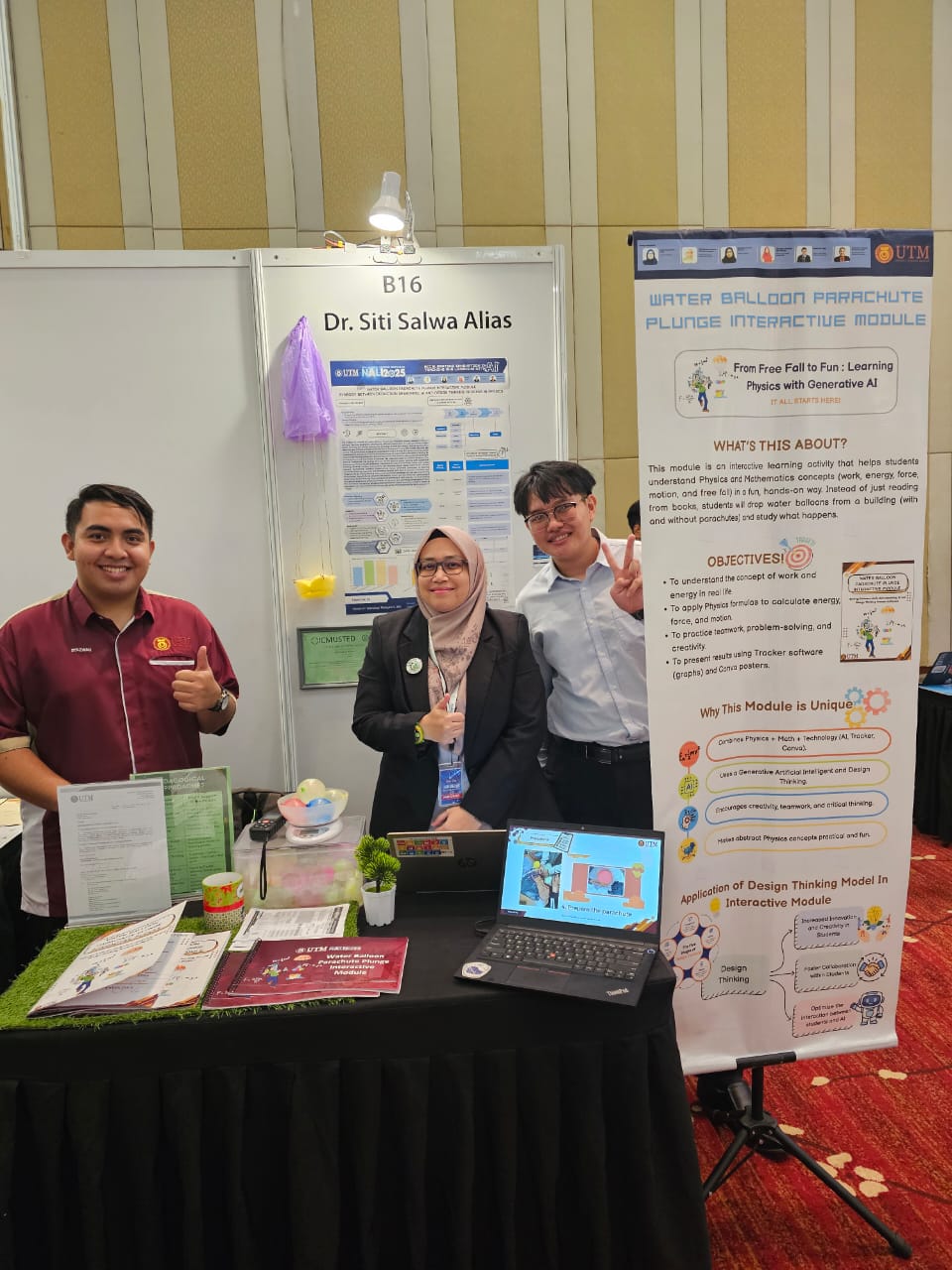
The Faculty of Science, Universiti Teknologi Malaysia (UTM), through the Department of Physics and the Centre for Sustainable Nanomaterials (CSNano), Ibnu Sina Institute for Scientific and Industrial Research (ISI-SIR), has pioneered a groundbreaking teaching innovation — the Water Balloon Parachute Plunge Interactive Module.
Developed by Dr. Siti Salwa Alias and her interdisciplinary team — Dr. Muhammad Syazwan Mohd Zaironi, Dr. Kuang Han Yong, Dr. Maisarah Duralim, Dr. Nor Farahwahidah Abd Rahman, and Dr. Nurzal Effiyana Ghazali — the module integrates Design Thinking, Artificial Intelligence (AI), and Project-Based Learning (PBL) to revolutionize the teaching and learning of physics
Reimagining Physics Through Real-World Challenges
The Water Balloon Parachute Module transforms abstract physics concepts into hands-on, meaningful experiences. Students are tasked with a relatable challenge — designing a parachute to prevent a water balloon from bursting when dropped from a height.
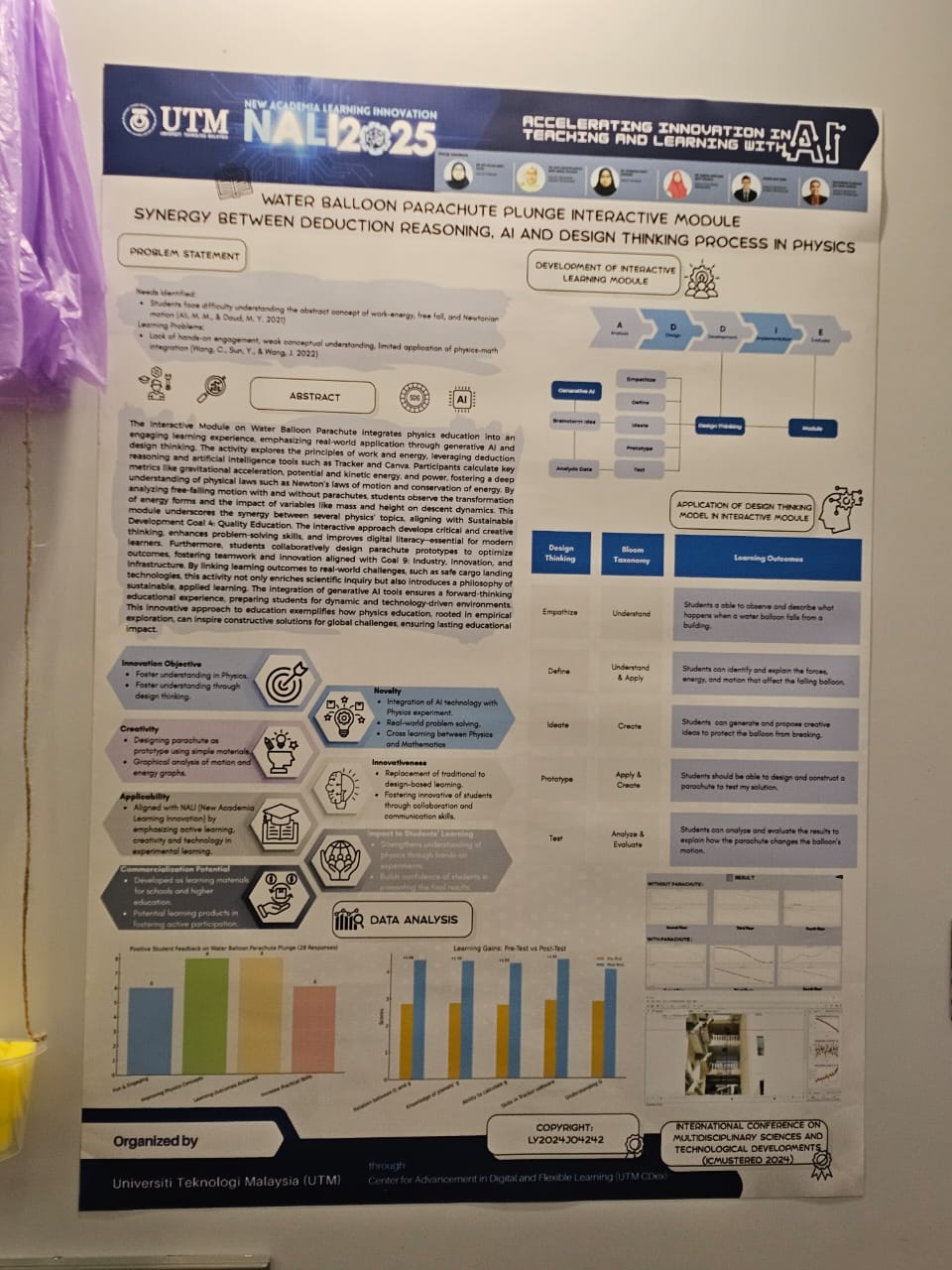
Through this creative exercise, learners apply key physics principles such as Newton’s Laws of Motion, gravitational force, energy transformation, and drag force. The process follows the five phases of Design Thinking — Empathize, Define, Ideate, Prototype, and Test — promoting iterative learning and real-world problem-solving
To complement the physical experimentation, students utilize AI tools like ChatGPT for brainstorming, Tracker Software for motion analysis, and Canva for digital visualization. This hybrid approach bridges theory and practice, encouraging scientific inquiry, creativity, and teamwork.
“We wanted students to see physics not just as formulas on a board, but as something they can touch, test, and improve — just like engineers and innovators do,” said Dr. Siti Salwa.
Integrating AI and Design Thinking
The module aligns with the New Academia Learning Innovation (NALI) framework by combining digital literacy, creativity, and collaboration in one learning ecosystem. The instructional design merges the ADDIE Model (Analysis, Design, Development, Implementation, Evaluation) with Design Thinking, ensuring each stage is both structured and student-centered.
AI integration enhances every phase:
- During Empathize and Define, students use AI to research challenges and propose solutions.
- In the Ideate and Prototype stages, they design models and predict performance using digital tools.
- Finally, in the Test phase, data from the parachute experiments are analyzed using Tracker Software, providing accurate motion and energy profiles.
This pedagogical synergy encourages critical thinking, scientific creativity, and ethical AI use in classroom environments
Remarkable Improvements in Learning Outcomes
The implementation of the Water Balloon Parachute Module showed substantial improvements in student understanding and engagement. Based on pre- and post-test evaluations, the team recorded an average 50–55% increase in student performance.
Among the notable learning gains:
|
Concept |
Pre-Test |
Post-Test |
Gain |
|
Understanding the relationship between gravitational constant (G) and acceleration (g) |
2.79 |
4.44 |
+1.66 |
|
Knowledge of planetary gravitational differences |
2.82 |
4.41 |
+1.59 |
|
Ability to calculate gravitational acceleration (g) |
2.75 |
4.33 |
+1.55 |
|
Skills in using Tracker Software for data analysis |
2.93 |
4.48 |
+1.55 |
|
Understanding of universal gravitational constant (G) |
2.89 |
4.41 |
+1.51 |
These results confirm that AI-assisted project-based learning can effectively enhance both conceptual understanding and scientific skills, particularly in mechanics and motion topics.
“Students began to see connections between physics, design, and engineering. It built not only their knowledge but also their confidence and teamwork,” added Dr. Siti Salwa.
Shaping Future Innovators Through Active Learning
Beyond academic improvement, the module cultivates essential 21st-century skills — problem-solving, collaboration, and creativity. Students learn to combine analytical thinking with experimentation, reflecting the multidisciplinary nature of real-world science and engineering.
The innovation also demonstrates how AI can be used ethically and productively in education — not as a shortcut, but as a cognitive partner that enhances inquiry, precision, and reflection.
Aligned with UTM’s mission of fostering future-ready graduates, the project offers a scalable model for other STEM disciplines. Its adaptable framework can be applied to topics such as fluid mechanics, energy transformation, and aerodynamics, or expanded into school outreach programs to ignite interest in STEM among younger learners
Conclusion
The Water Balloon Parachute Plunge Interactive Module showcases how integrating AI, Design Thinking, and experiential learning can transform traditional science education. It bridges the gap between theory and practice, inspiring students to think critically, design creatively, and innovate sustainably.
By merging pedagogy, technology, and hands-on exploration, UTM continues to lead Malaysia’s movement toward AI-empowered, learner-centered education, ensuring that tomorrow’s scientists and engineers are both technologically fluent and human-centered innovators.
📍 Project Title: Water Balloon Parachute: Synergy Between Generative AI, Design Thinking Process, and Project-Based Learning in Physics Education
👩🏫 Principal Investigator: Dr. Siti Salwa Alias, Department of Physics, Faculty of Science, Universiti Teknologi Malaysia
📧 Contact: siti.salwa@utm.my
🔗 Learn more about UTM’s research and teaching innovations at: https://science.utm.my/utmfsresearch/