SITI PAULIENA MOHD BOHARI*
Corresponding author : pauliena@utm.my
Dr. Siti Pauliena Mohd Bohari is a member of BioInspired Device and Tissue Engineering (BIOINSPIRE) and a Senior Lecturer in the Department of Biosciences, Faculty of Science, UTM.
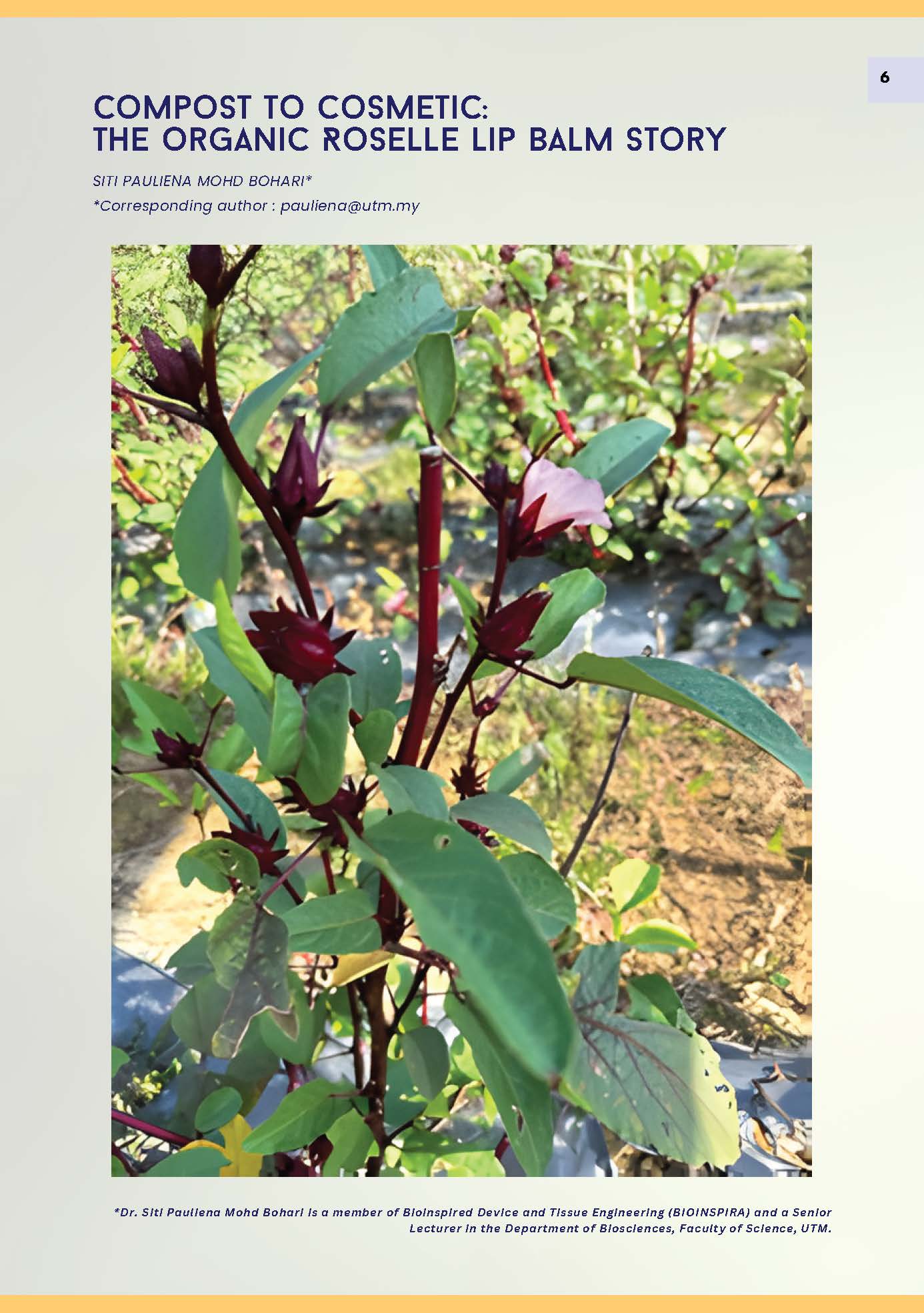
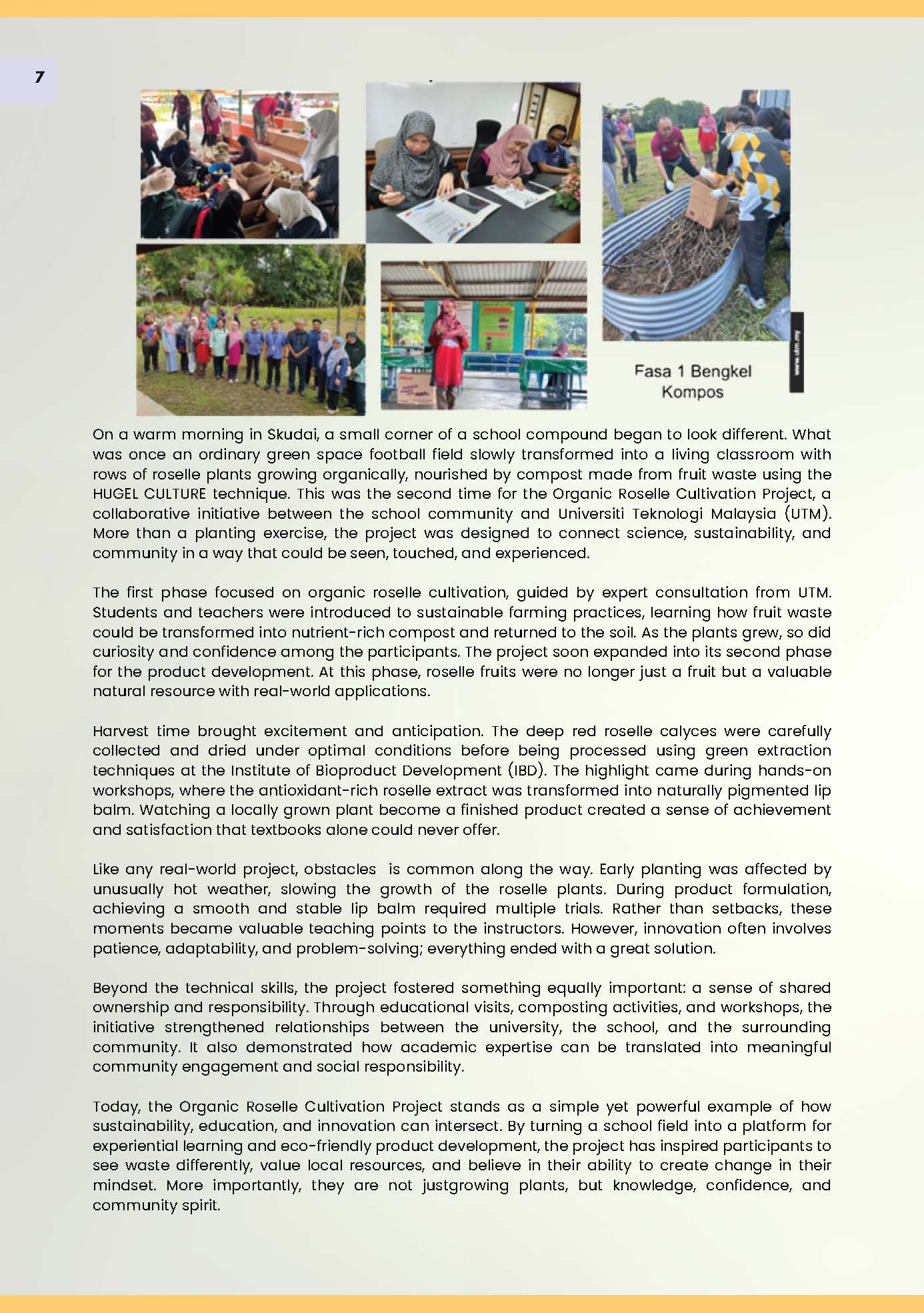
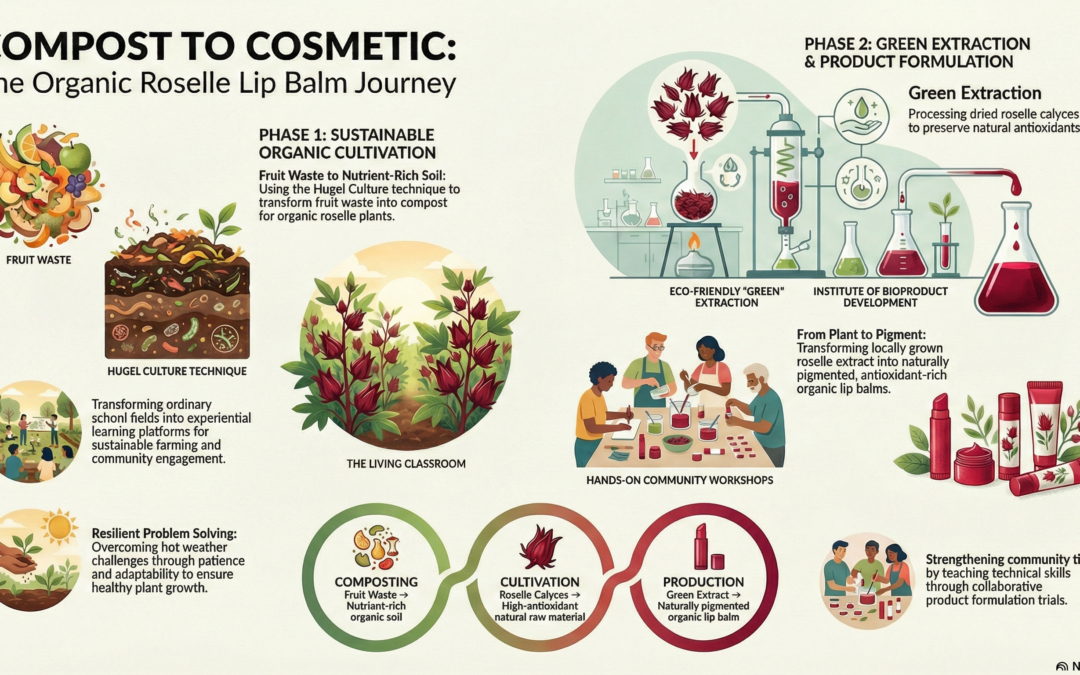
On a warm morning in Skudai, a small corner of a school compound began to look different. What was once an ordinary green space football field slowly transformed into a living classroom with rows of roselle plants growing organically, nourished by compost made from fruit waste using the HUGEL CULTURE technique. This was the second time for the Organic Roselle Cultivation Project, a collaborative initiative between the school community and Universiti Teknologi Malaysia (UTM). More than a planting exercise, the project was designed to connect science, sustainability, and community in a way that could be seen, touched, and experienced.
The first phase focused on organic roselle cultivation, guided by expert consultation from UTM. Students and teachers were introduced to sustainable farming practices, learning how fruit waste could be transformed into nutrient-rich compost and returned to the soil. As the plants grew, so did curiosity and confidence among the participants. The project soon expanded into its second phase for the product development. At this phase, roselle fruits were no longer just a fruit but a valuable natural resource with real-world applications.
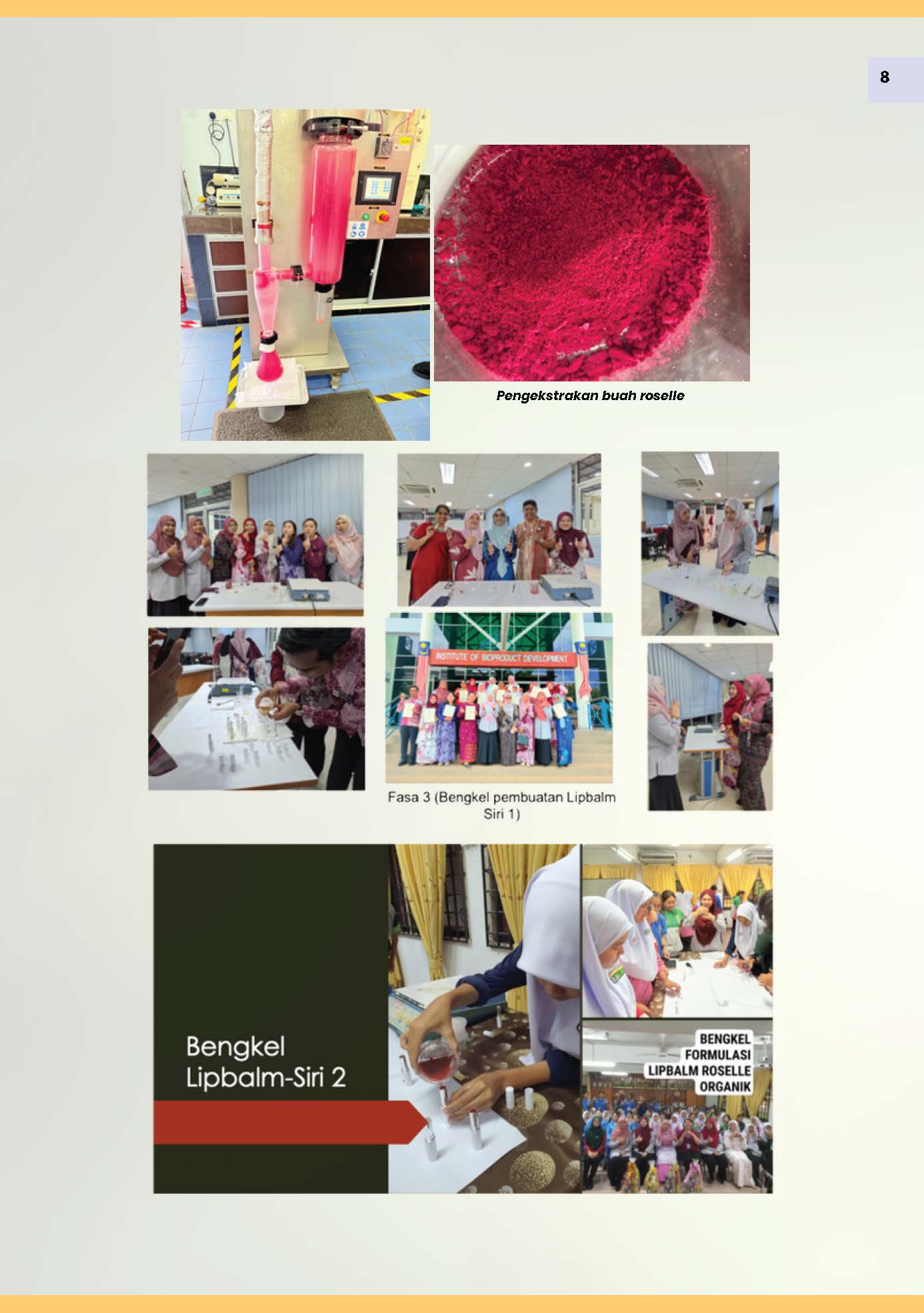
Harvest time brought excitement and anticipation. The deep red roselle calyces were carefully collected and dried under optimal conditions before being processed using green extraction techniques at the Institute of Bioproduct Development (IBD). The highlight came during hands-on workshops, where the antioxidant-rich roselle extract was transformed into naturally pigmented lip balm. Watching a locally grown plant become a finished product created a sense of achievement and satisfaction that textbooks alone could never offer.
Like any real-world project, obstacles is common along the way. Early planting was affected by unusually hot weather, slowing the growth of the roselle plants. During product formulation, achieving a smooth and stable lip balm required multiple trials. Rather than setbacks, these moments became valuable teaching points to the instructors. However, innovation often involves patience, adaptability, and problem-solving; everything ended with a great solution.
Beyond the technical skills, the project fostered something equally important: a sense of shared ownership and responsibility. Through educational visits, composting activities, and workshops, the initiative strengthened relationships between the university, the school, and the surrounding community. It also demonstrated how academic expertise can be translated into meaningful community engagement and social responsibility.
Today, the Organic Roselle Cultivation Project stands as a simple yet powerful example of how sustainability, education, and innovation can intersect. By turning a school field into a platform for experiential learning and eco-friendly product development, the project has inspired participants to see waste differently, value local resources, and believe in their ability to create change in their mindset. More importantly, they are not just growing plants, but knowledge, confidence, and community spirit.