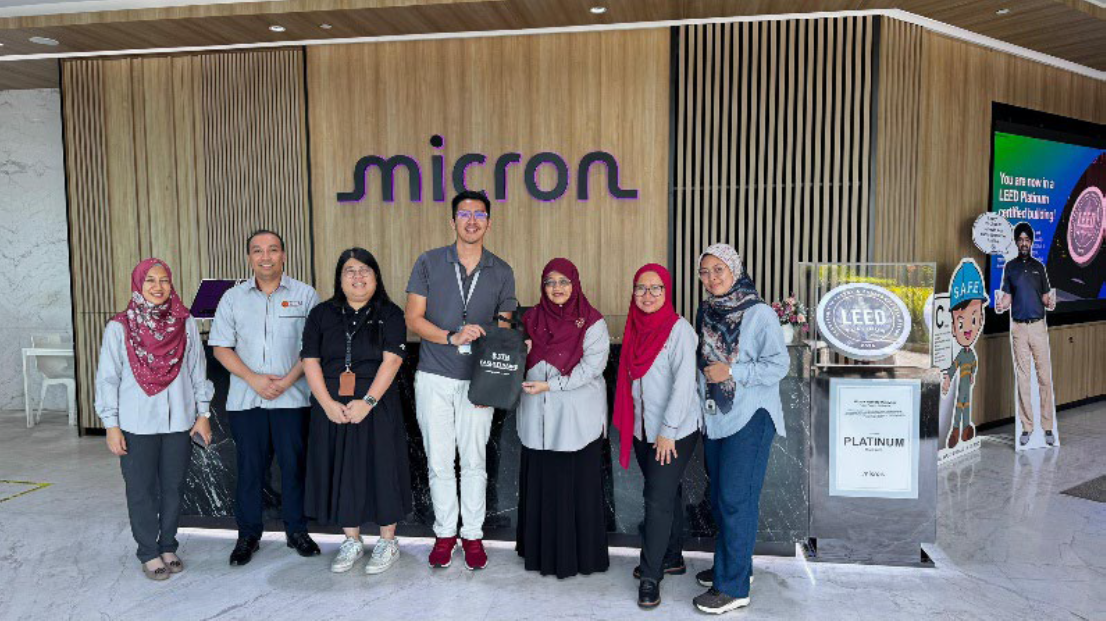
PENANG, 22 April 2026 – The Faculty of Science (FS), Universiti Teknologi Malaysia (UTM), has taken a significant step in strengthening academia–industry collaboration through a strategic engagement visit to Micron Memory Malaysia Sdn. Bhd., one of the world’s leading semiconductor companies.
The delegation, led by the Dean of the Faculty of Science, Assoc. Prof. Dr. Shafinaz Shahir, included key academic representatives from the Department of Physics. The visit was a follow-up initiative stemming from the successful participation of four UTM academic staff in the Micron Semiconductor Package Assembly & Test Professional (SAT-PRO) programme in September 2025.
Strategic Engagement and Industry Insights
The programme commenced with a welcoming session by Micron’s Director of Talent Acquisition, followed by an institutional address from the Dean. A comprehensive strategic discussion was then held, covering talent development strategies, university engagement frameworks, and potential collaborations in semiconductor materials and fabrication technologies.
A key highlight of the visit was an exclusive tour of Micron’s cleanroom production facility, where participants gained first-hand exposure to advanced semiconductor manufacturing processes. This industrial immersion provided valuable insights into real-world applications, reinforcing the importance of aligning academic curricula with current industry needs.
Driving Curriculum Innovation and Talent Development
One of the major outcomes of the engagement was the mutual commitment to enhance graduate employability. Both parties discussed integrating semiconductor physics elements into existing curricula, as well as introducing the SAT-PRO programme as an elective course for students.
Additionally, Micron expressed strong interest in:
- Expanding student internship placements (12 weeks to 6 months)
- Supporting curriculum development
- Delivering industry lectures and workshops
- Participating in Industry Advisory Boards
- Strengthening talent pipeline initiatives and recruitment
The visit also featured a presentation on the proposed Master of Science in Physics and Technology (Semiconductor and Electronics) programme, where Micron representatives provided constructive feedback on course structure, core subjects, and elective offerings.
Enhancing Employability and Research Collaboration
The collaboration is expected to significantly boost employability among Physics graduates, particularly within multinational corporations (MNCs). Discussions also opened opportunities for:
- Joint research collaborations
- Translational research initiatives
- Academic–industry mobility programmes, including short-term industrial attachments for lecturers
Furthermore, engagement with UTM alumni currently working at Micron added a valuable dimension in bridging academic learning with industry expectations.
Towards Long-Term Strategic Partnership
To sustain the momentum, the Faculty has proposed formalising the collaboration through a Memorandum of Understanding (MoU) or Letter of Intent (LoI). While Micron has expressed openness to this, the company emphasised the need for strong, long-term commitment from both parties prior to formalisation.
Programme Impact and Reflections
Overall, the programme successfully achieved its objectives by:
- Strengthening strategic ties between UTM and a global semiconductor leader
- Providing meaningful industrial exposure to academic staff
- Supporting curriculum enhancement aligned with global industry standards
- Creating pathways for student training and employment opportunities
Despite minor financial constraints—where actual expenditure slightly exceeded the approved budget—the programme delivered high-impact outcomes that justify its strategic importance.
Conclusion
This engagement marks a pivotal milestone in UTM’s ongoing efforts to bridge the gap between academia and industry. By fostering closer collaboration with Micron Malaysia, the Faculty of Science continues to position itself at the forefront of industry-relevant education, research innovation, and graduate employability, in line with the aspirations of UTM ASCEND 2030.