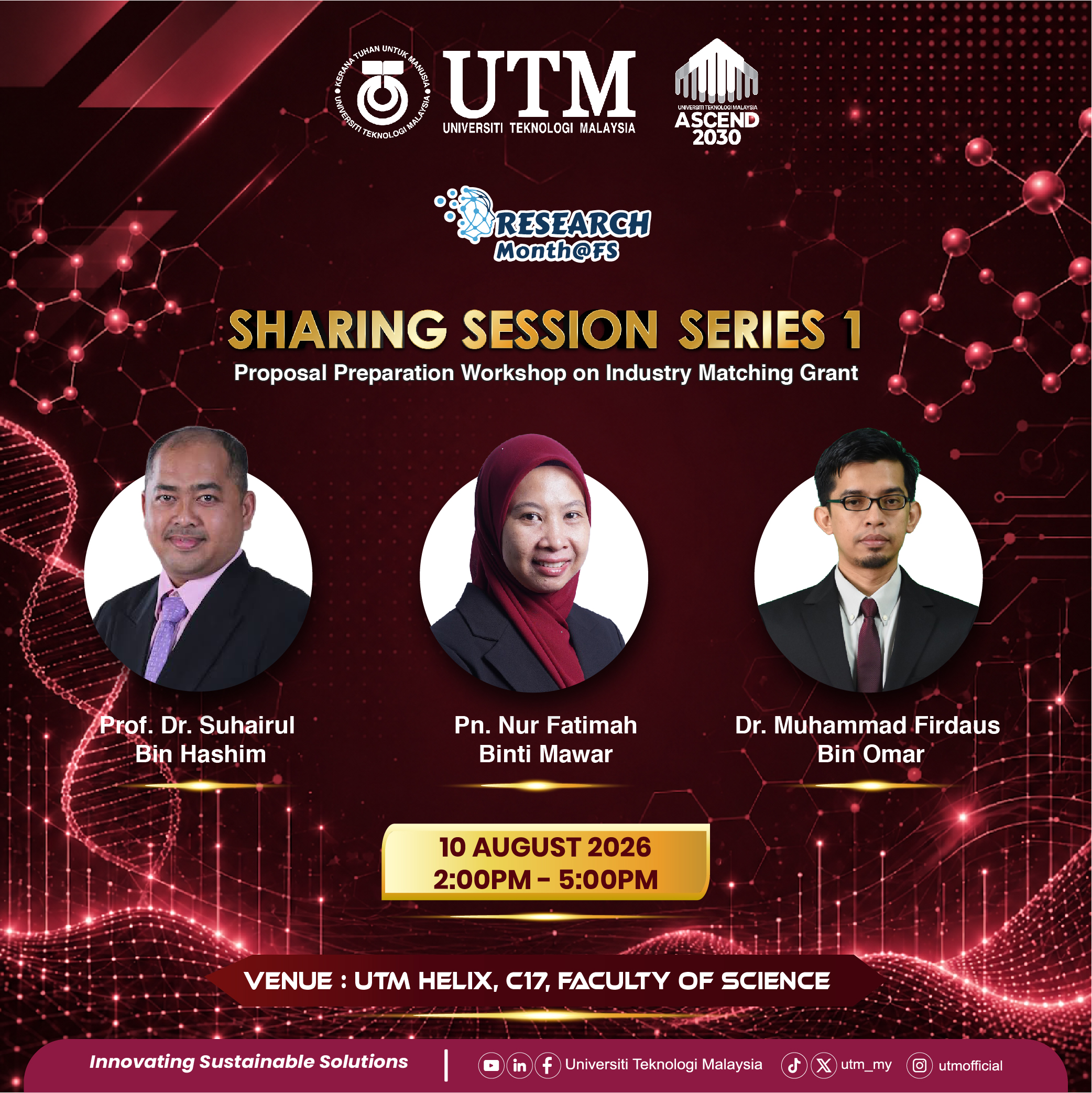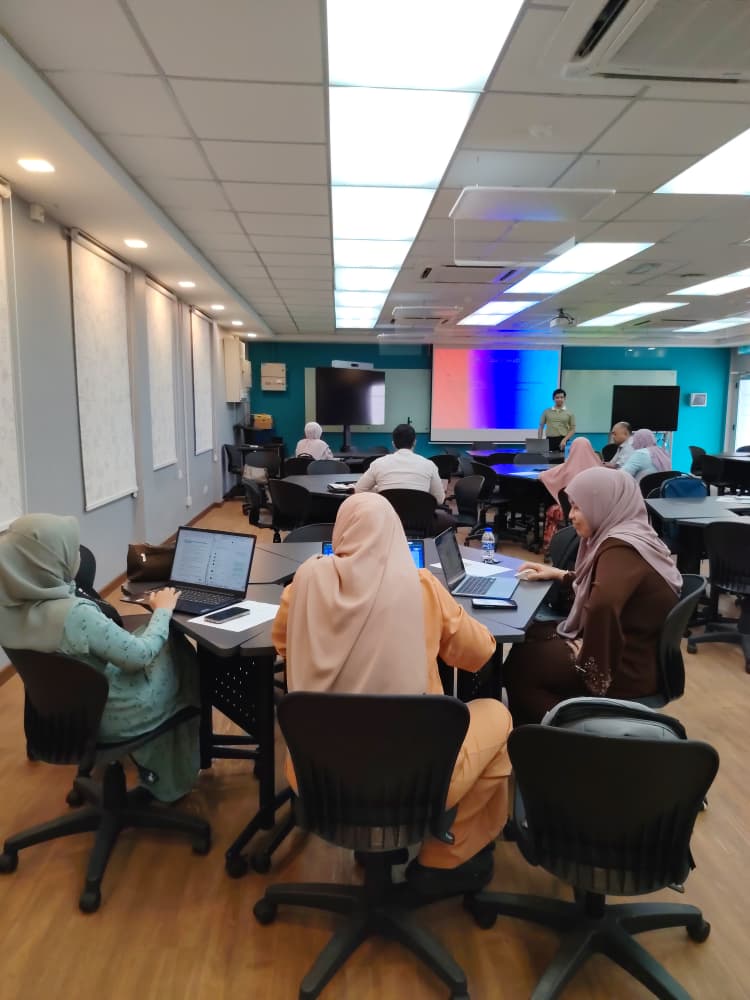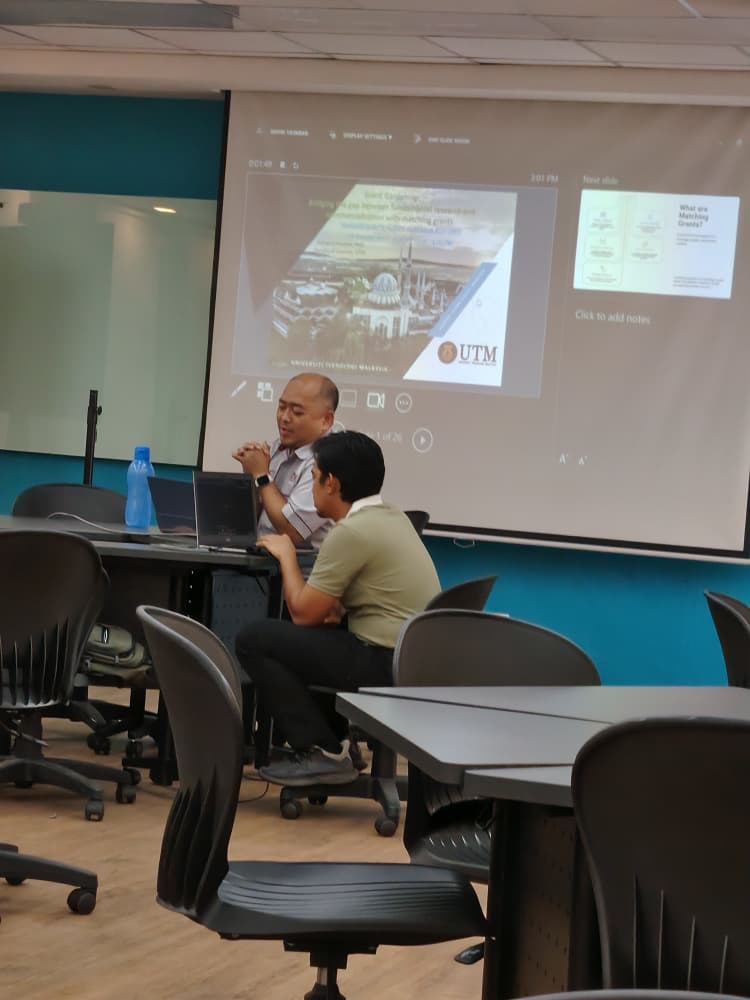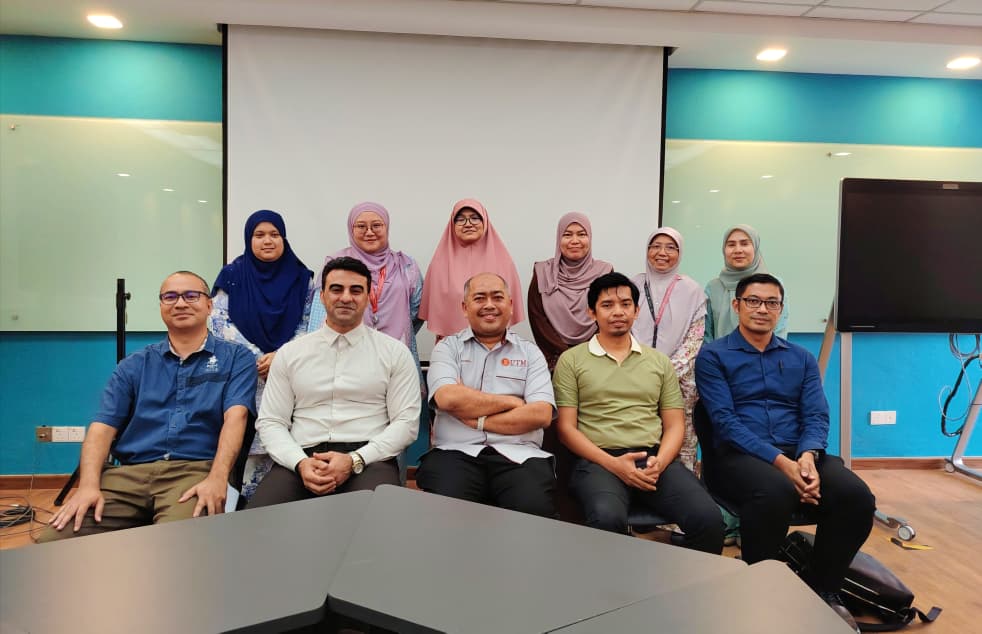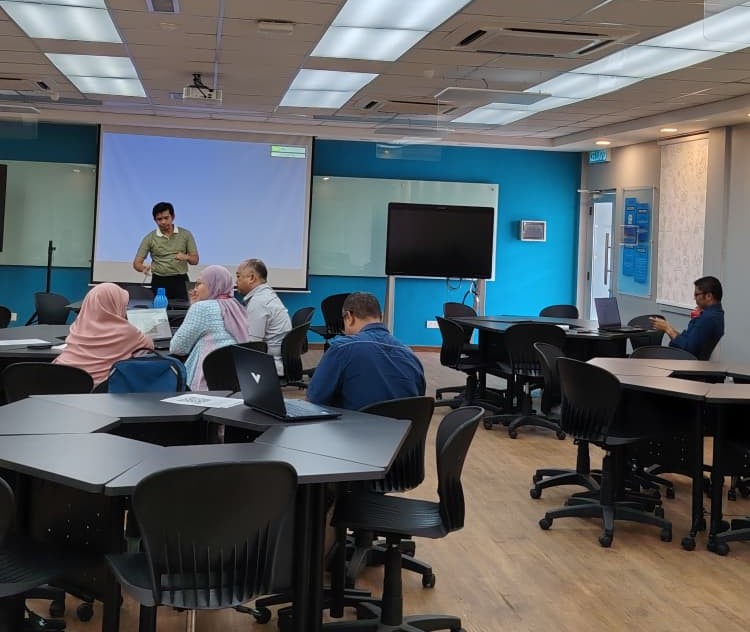
JOHOR BAHRU, 10 August 2026 – The Faculty of Science, Universiti Teknologi Malaysia (UTM), organised Sharing Session Series 1: Proposal Preparation Workshop on Industry Matching Grant in conjunction with Research Month @FS 2026 at UTM HELIX, C17, Faculty of Science.
The session featured Prof. Dr. Suhairul Bin Hashim, Pn. Nur Fatimah Binti Mawar, and Dr. Muhammad Firdaus Bin Omar, who shared practical guidance on developing collaborative research, preparing competitive proposals, and strengthening engagement with industry partners.
A key component of the workshop introduced participants to the UTM Collaborative Grant (UTM CG), previously known as the Matching Grant. UTM CG is an internal research grant that complements research costs or specific activities carried out with collaborators. The scheme is structured around programme and project concepts, and the need for UTM CG support must be stated in the Letter of Award or Memorandum of Agreement received from the collaborator.
Participants were briefed on the two UTM CG categories. Under UTM CG 1, both collaborator funding and UTM CG funding are channelled to the UTM researcher, while under UTM CG 2, the collaborator retains its own funding and only the UTM CG allocation is channelled to the UTM researcher. The grant aims to accelerate collaborative research, strengthen national and international networks, increase opportunities for external funding and catalyse impactful research projects.
The session also covered eligibility requirements, application documentation, funding rules, expected outputs and the proposal evaluation process. Participants were reminded that a strong proposal should clearly present the problem statement, research background, SMART objectives, detailed methodology, expected outputs and a realistic budget. The evaluation also considers the potential impact of the project, including competitiveness, funder reputation, publication outcomes and contribution to the Sustainable Development Goals.
Important financial requirements were also highlighted, including a maximum of 20% of the approved allocation for travel and 40% for equipment. ICT items such as laptops, phones and printers are not permitted, while all expenditure must be directly related to the research activities.
Complementing the institutional guidance, Dr. Muhammad Firdaus Bin Omar shared his experience in translating research expertise into successful industry collaborations. His presentation focused on areas including semiconductors, thin films, nanomaterials, instrumentation, vacuum systems and material characterisation.
Drawing from his research portfolio, he highlighted 16 approved projects, more than 10 industry-impact projects and cumulative funding exceeding RM530,000 across fundamental grants, contract research, PPRN and industry incentive projects. Examples included projects involving PE-MOCVD and AlN thin films, Raman-based characterisation, RF amplifier systems and semiconductor process control.
The sharing session emphasised that a sustainable industry-research relationship often begins by identifying real industrial “pain points” and matching them with relevant university expertise. Researchers were encouraged to begin with smaller projects as a “stepping-stone” to establish trust before progressing to larger contract research or PPRN projects. They were also encouraged to leverage specialised university facilities as added value and to ensure timely project delivery to strengthen opportunities for repeat collaboration.
Another important message was the progression of research from fundamental work to industrial application. Fundamental grants can support early-stage scientific development, while industry-oriented funding can help translate established knowledge into prototypes, technical solutions and higher-TRL outcomes that address actual company needs.
The workshop reinforced the view that industry grants are more than financial support; they also represent industry recognition of a researcher’s expertise and problem-solving capability. By combining strong proposals, relevant expertise, appropriate facilities and effective collaboration, researchers can build sustainable partnerships that generate academic, industrial and societal impact.
Through Research Month @FS 2026, the Faculty of Science continues to strengthen the capabilities of its researchers in grant preparation, collaboration and research translation, while supporting UTM’s broader aspiration to create impactful and sustainable research partnerships.
#FSResearchMonth2026
#utmfsresearch