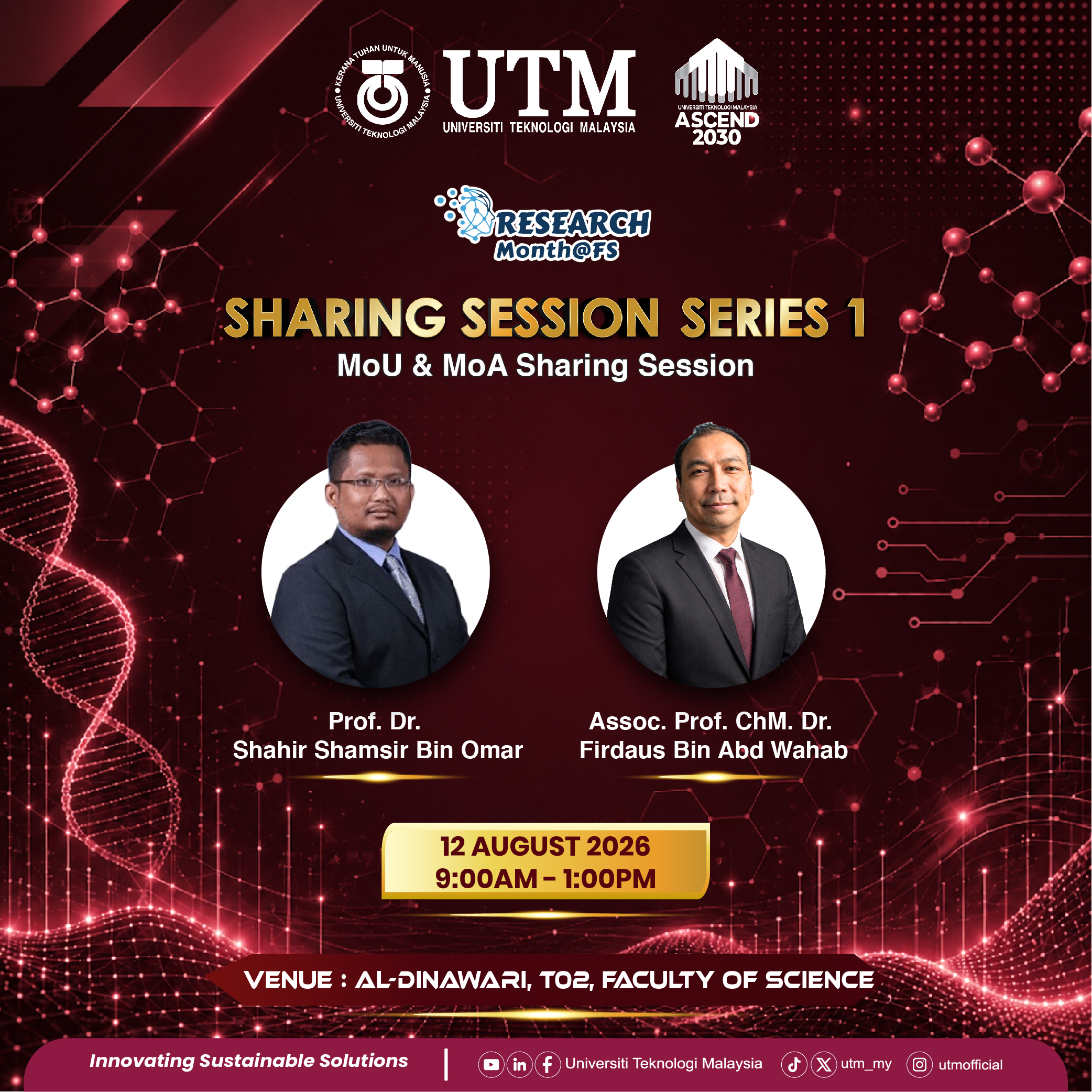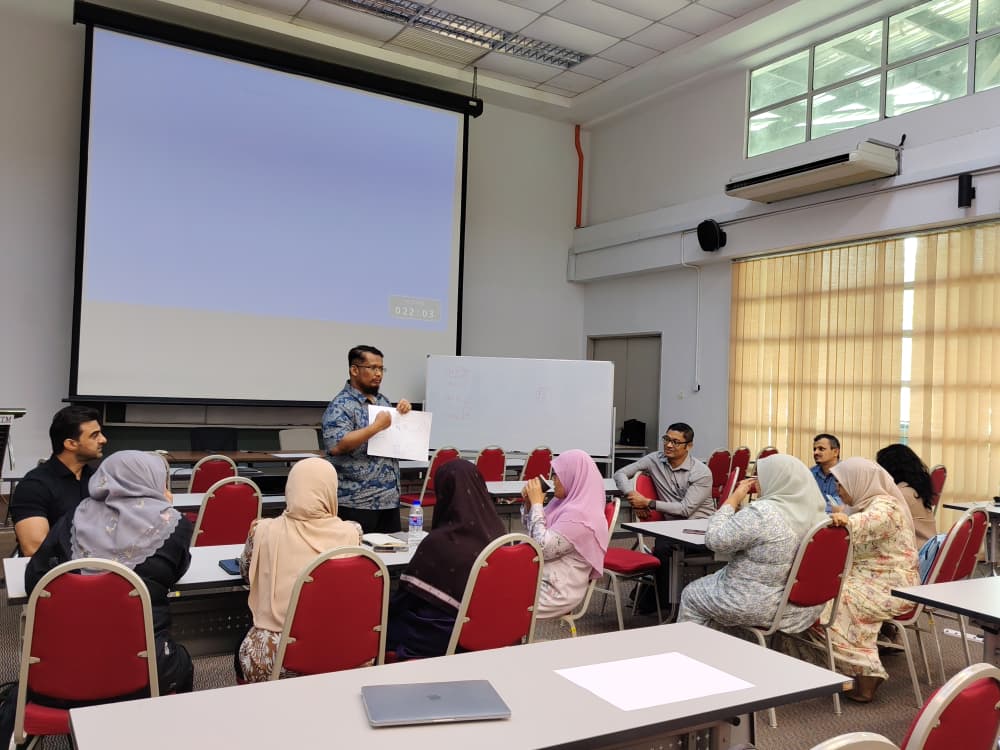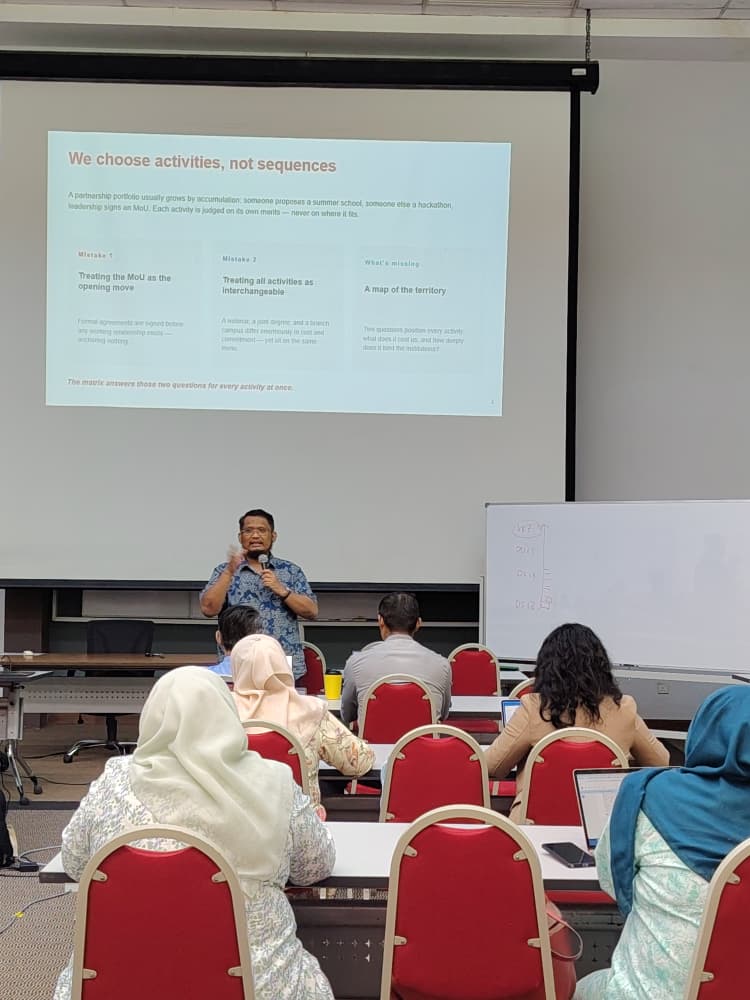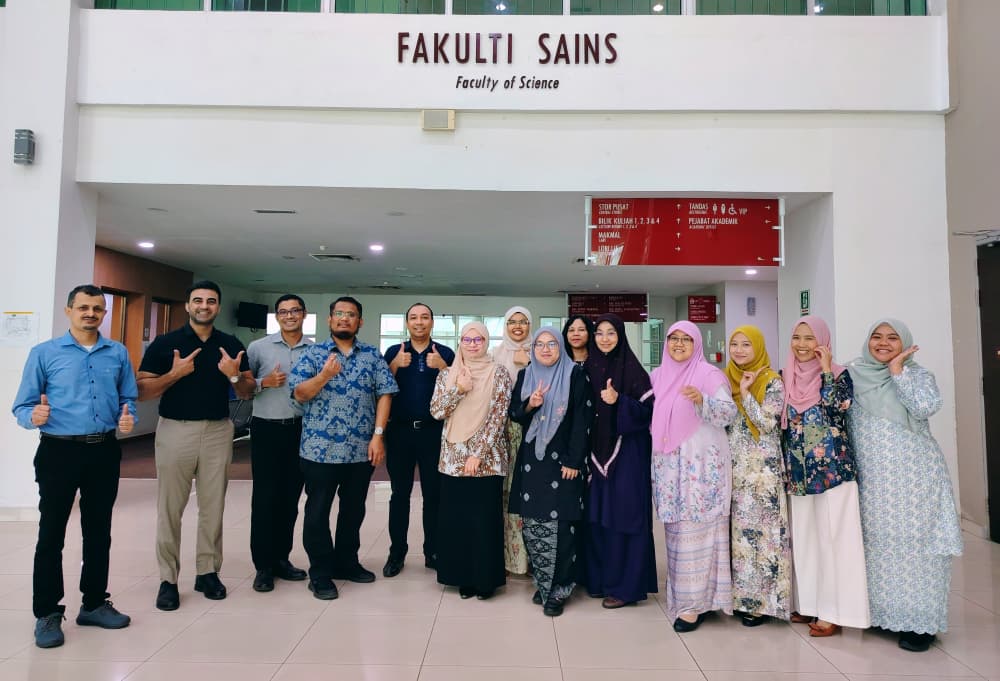
JOHOR BAHRU, 12 August 2026 – The Faculty of Science, Universiti Teknologi Malaysia (UTM), organised Sharing Session Series 1: MoU & MoA Sharing Session in conjunction with Research Month @FS 2026 at Al-Dinawari Hall, T02, Faculty of Science.
The session featured Prof. Dr. Shahir Shamsir Bin Omar and Assoc. Prof. ChM. Dr. Firdaus Bin Abd Wahab, who shared strategic and practical perspectives on developing, formalising and sustaining productive institutional collaborations.
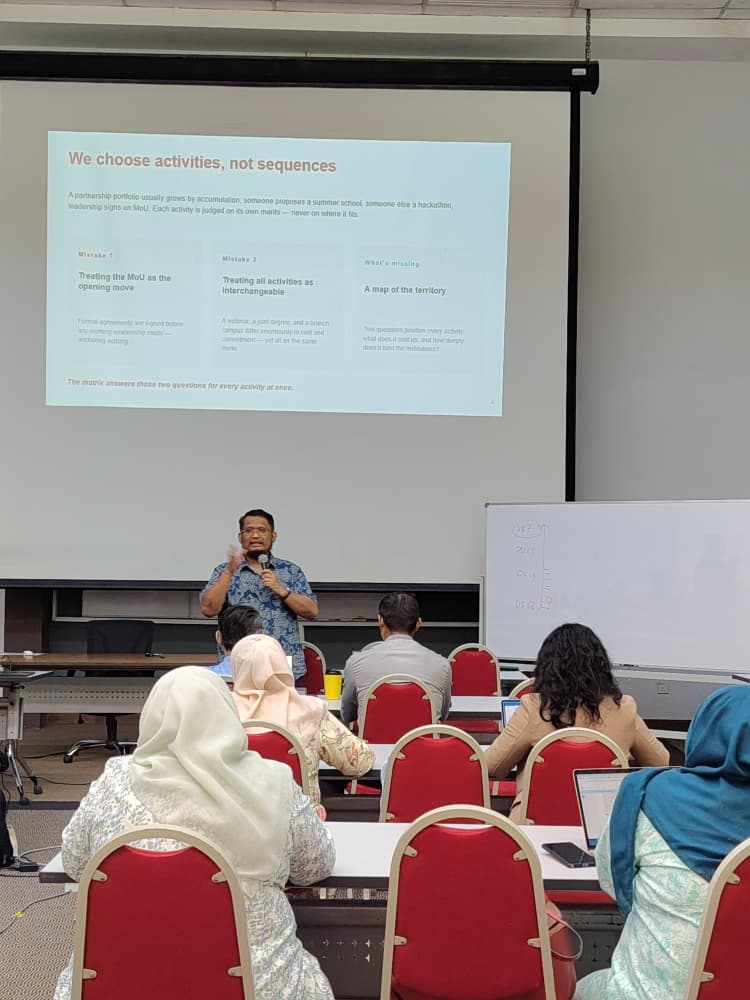
A key message of the session was that a Memorandum of Understanding (MoU) should not be viewed merely as the starting point of a partnership. Prof. Dr. Shahir highlighted the risk of the “Empty MoU” – an agreement that is signed and publicised but produces little subsequent collaborative activity. Instead, formal agreements should ideally anchor relationships that have already demonstrated evidence of collaboration through activities such as joint authorship, guest lectures, workshops, research visits and collaborative grant applications.
He introduced the Institutional Partnership Matrix, a decision-making framework that positions collaborative activities according to two dimensions: resource commitment and institutional embeddedness. The framework groups activities into four stages – Trust Building, Institutional Anchoring, Showcase & Sprint, and Strategic Lock-In – providing researchers with a structured pathway for developing collaborations progressively rather than treating individual activities as isolated initiatives.
Under this approach, partnerships may begin with relatively low-resource activities such as joint publications, online guest lectures and workshops before progressing towards collaborative grant writing, formal agreements and adjunct appointments. More mature partnerships may subsequently develop into joint conferences, mobility programmes, long-term research partnerships, collaborative research centres or joint academic programmes.
The presentation also demonstrated how sustainable partnerships develop through a sequence of increasingly meaningful activities. A case study involving UTM and the University of Kent illustrated a 13-year progression from a visiting guest lecture in 2007 to the establishment of a double-degree programme in 2020, showing how informal collaboration and institutional anchoring can provide a strong foundation for deeper strategic engagement.
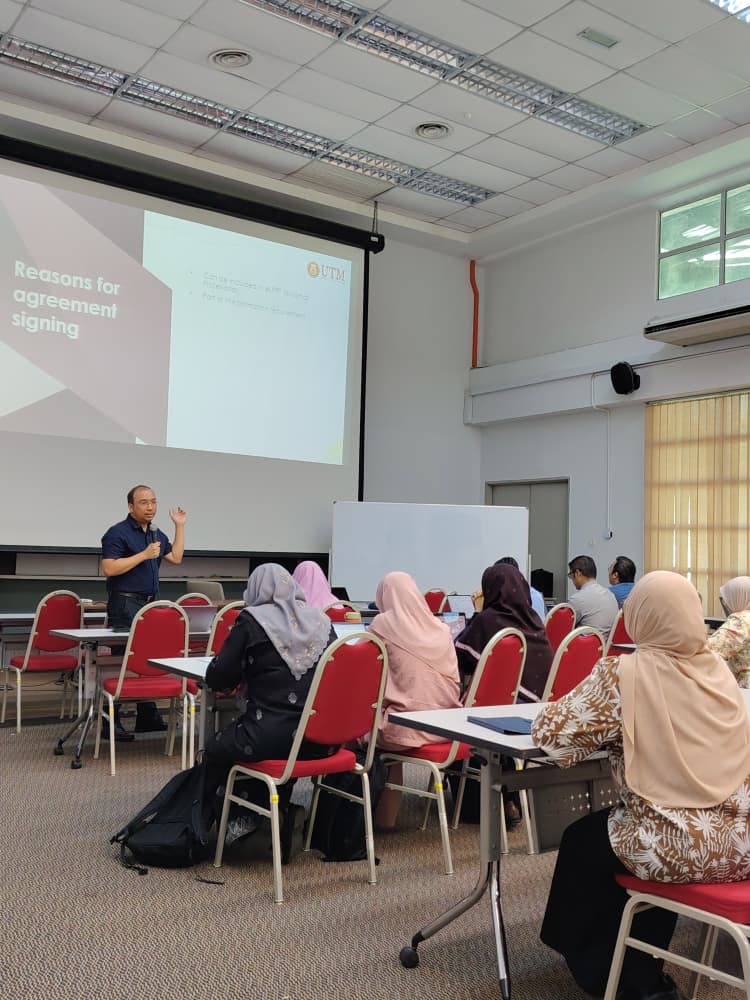
Complementing the strategic perspective, Assoc. Prof. ChM. Dr. Firdaus Bin Abd Wahab, Manager of External and Global Engagement at the Faculty of Science, explained the UTM agreement signing application process and the different forms of agreements available to researchers. These include the Letter of Intent (LoI), Letter of Collaboration (LoC), Memorandum of Understanding (MoU), Memorandum of Agreement (MoA), Specific Engagement Agreement (SEA), Research Collaboration Agreement (RCA) and Non-Disclosure Agreement (NDA).
Participants were briefed that the appropriate agreement depends on the maturity and purpose of the collaboration. For example, an LoI may be used to initiate collaboration without prior joint activities, while an LoC is intended to strengthen an existing relationship following collaborative activities. A formal MoU requires evidence of established high-impact joint activities, whereas an MoA or SEA is used for specific projects involving contractual or financial commitments.
The session also covered practical considerations surrounding agreement execution, including electronic signing, postal arrangements and formal signing ceremonies. Participants were reminded that agreements requiring the signature of the Dean or higher university management must first go through the appropriate Faculty external and global engagement channel. Following the signing of an agreement, the person-in-charge is also expected to report collaborative activities regularly, particularly for international MoUs.
Together, the two presentations reinforced an important principle: successful partnerships should be built on real collaborative activities, formally anchored at the appropriate stage, and continuously strengthened through measurable outcomes.
The workshop provided Faculty of Science researchers with a clearer understanding of both the strategic development of institutional partnerships and the administrative processes required to formalise them. Through such initiatives, Research Month @FS 2026 continues to strengthen the Faculty’s capacity to build meaningful national and international collaborations that can generate research, mobility, innovation and funding opportunities.
#FSResearchMonth2026
#utmfsresearch