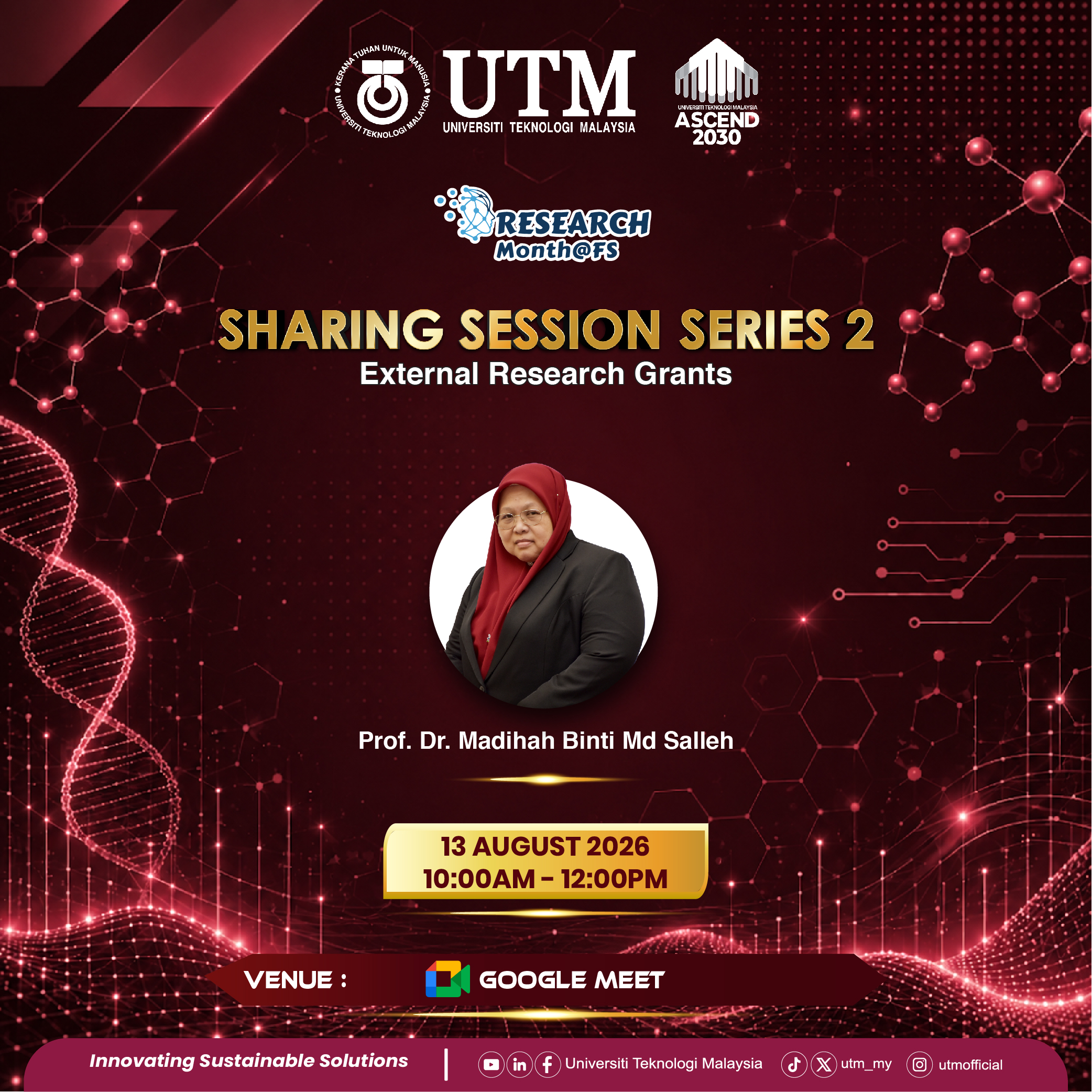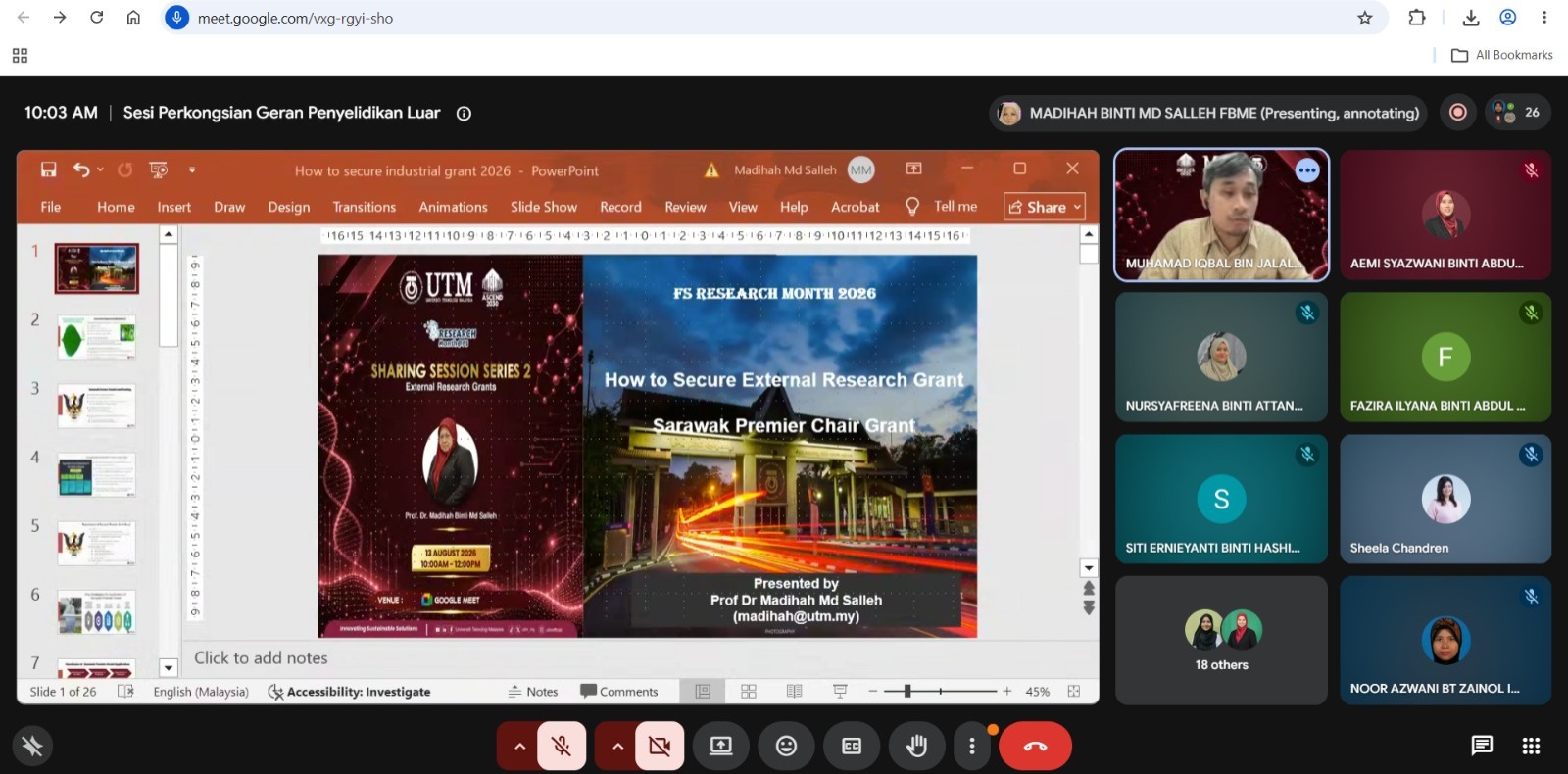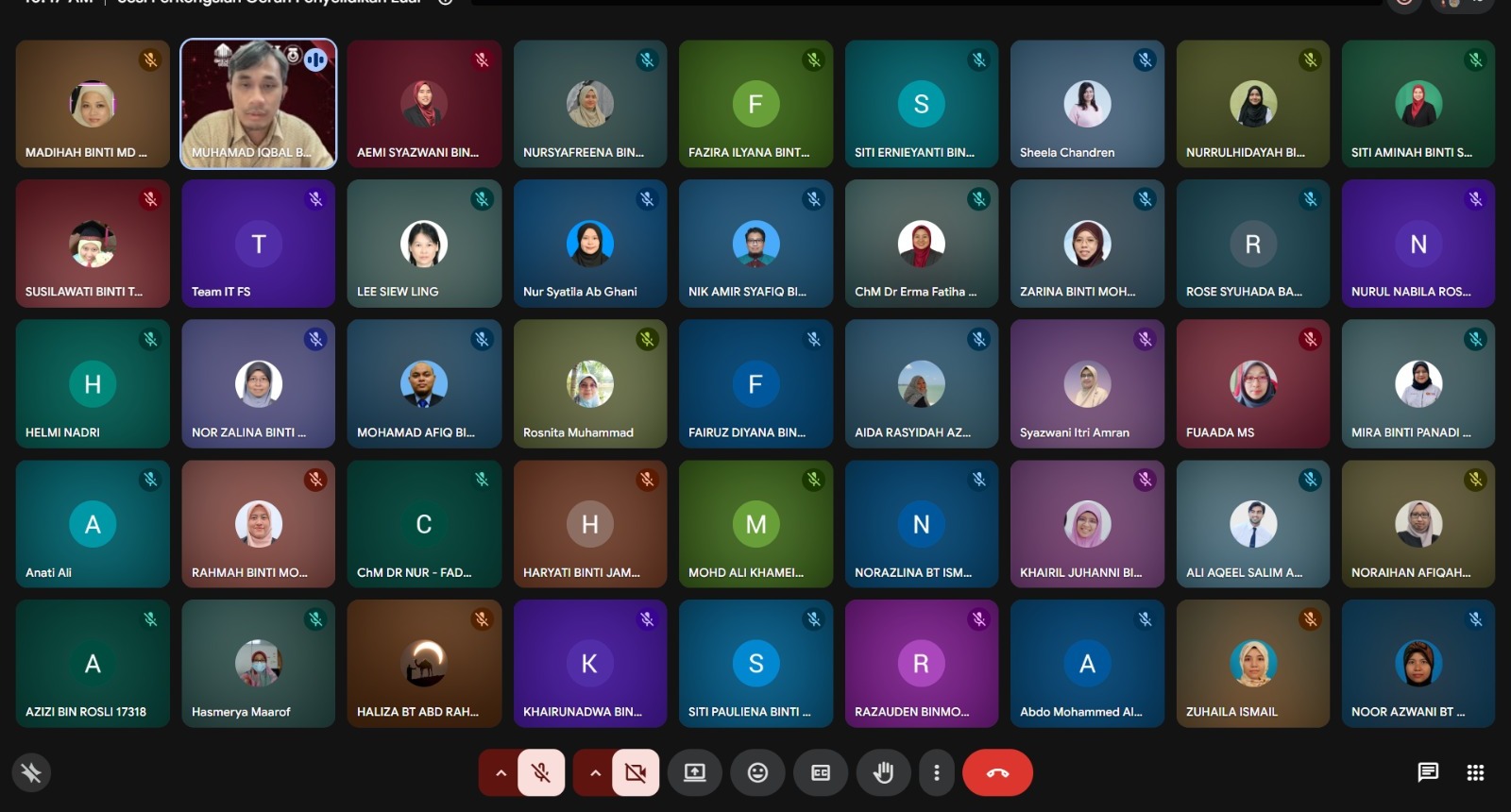
JOHOR BAHRU, 13 August 2026 – The Faculty of Science, Universiti Teknologi Malaysia (UTM), organised Sharing Session Series 2: External Research Grants in conjunction with Research Month @FS 2026, featuring Prof. Dr. Madihah Binti Md Salleh in an online session conducted via Google Meet.
Entitled “How to Secure External Research Grant – Sarawak Premier Chair Grant,” the session provided researchers with practical insights into identifying funding opportunities, building strategic partnerships, developing competitive proposals and managing externally funded research projects. Drawing from her experience in securing the Sarawak Premier Chair Grant, Prof. Dr. Madihah shared the complete journey from identifying stakeholders and developing the proposal to pitching, securing the award and implementing the research programme.
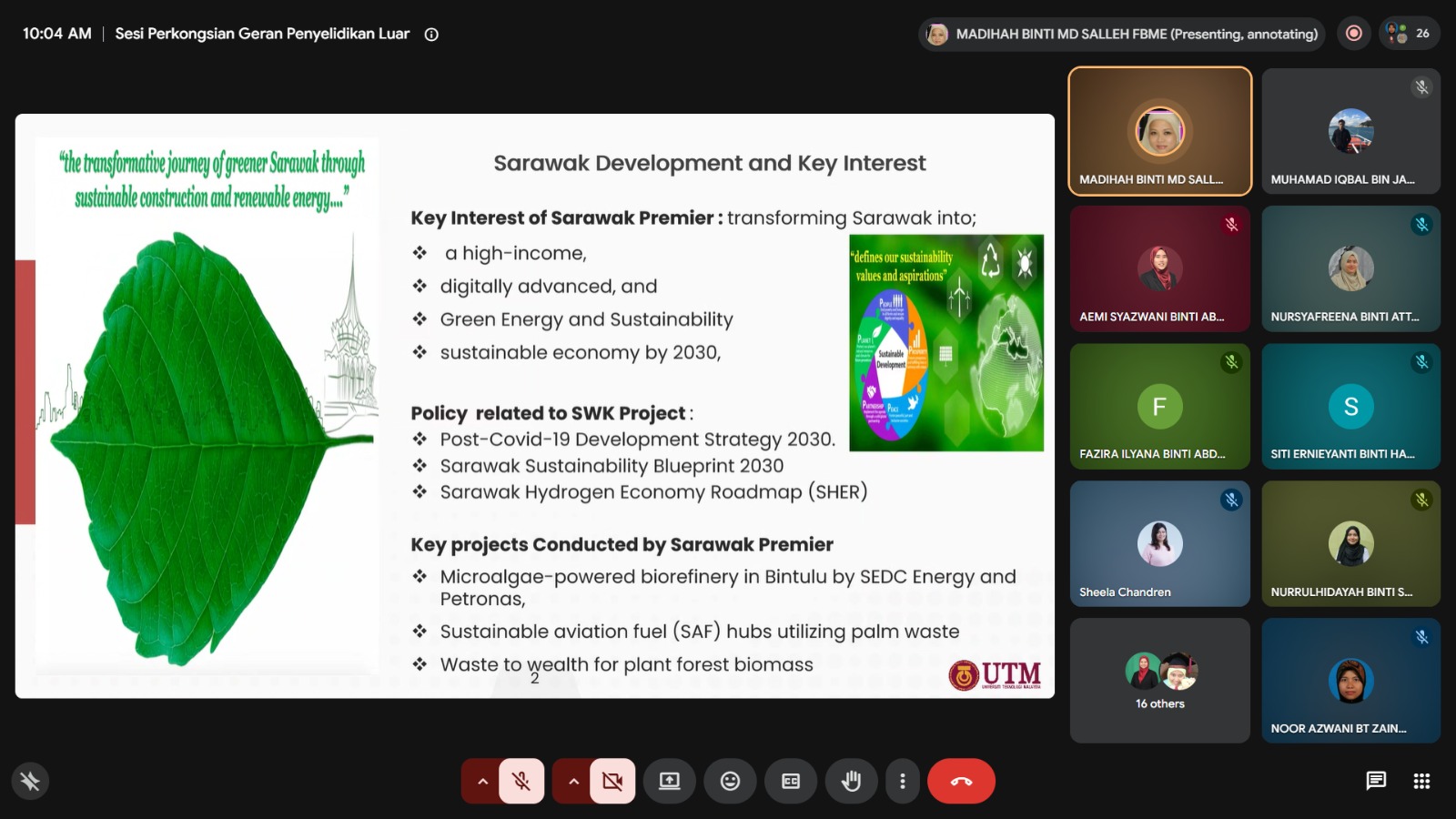
A central message of the session was the importance of understanding the priorities of the funding body before developing a proposal. Using the Sarawak Premier Chair Grant as a case study, participants were introduced to research priorities related to Sarawak’s development, including renewable energy, resources and water security, digital transformation and economy, smart city and tourism, and climate change. The grant emphasises applied research that contributes to the development of Sarawak and involves relevant agencies or stakeholders in the state.
Prof. Dr. Madihah highlighted that securing an external grant begins long before the proposal is written. Researchers need to actively build networks, identify suitable collaborators and understand the needs of potential stakeholders. Her own application process involved searching for information through established networks, identifying potential industry partners and selecting a stakeholder whose challenges could be addressed through UTM’s research expertise.
This approach led to collaboration with PUSAKA Capital Food Industry Sdn. Bhd., where discussions identified the substantial generation of waste from pineapple plantations as an industrial challenge. The research team subsequently explored how this biomass could be converted into products with economic and environmental value while aligning with Sarawak’s development priorities.
The resulting research programme, “Integrated Biorefinery Strategy for Sustainable Management of Pineapple Waste into High-Value Products,” integrated three complementary projects: the production of biohydrogen through submerged fermentation, the conversion of pineapple biomass into compost for soil enhancement and plant growth, and the valorisation of pineapple waste for pharmaceutical applications through bromelain.
The programme brought together researchers from UTM and partner institutions together with an industrial collaborator, demonstrating the importance of assembling expertise according to the specific needs of each sub-project. The integrated approach also incorporated Sustainable Development Goal elements and emphasised benefits to both industrial stakeholders and the wider development of Sarawak.
Prof. Dr. Madihah shared several important elements for developing a competitive external grant proposal. These include clearly demonstrating the integration between projects, justifying programme and project titles, developing strong and strategic partnerships, providing a convincing project description, demonstrating commercialisation potential, preparing a realistic and detailed budget, incorporating relevant SDGs and clearly showing how the proposed work will contribute to the funder’s priorities and stakeholder needs.
Attention was also given to the pitching stage. Researchers were encouraged to understand the background of the evaluation panel, present the project as a clear and concise story, explain the benefits to stakeholders, justify the budget and demonstrate a realistic roadmap for the future. Previous engagement with government agencies, industry, universities and society can also provide evidence of the team’s ability to deliver the proposed project.
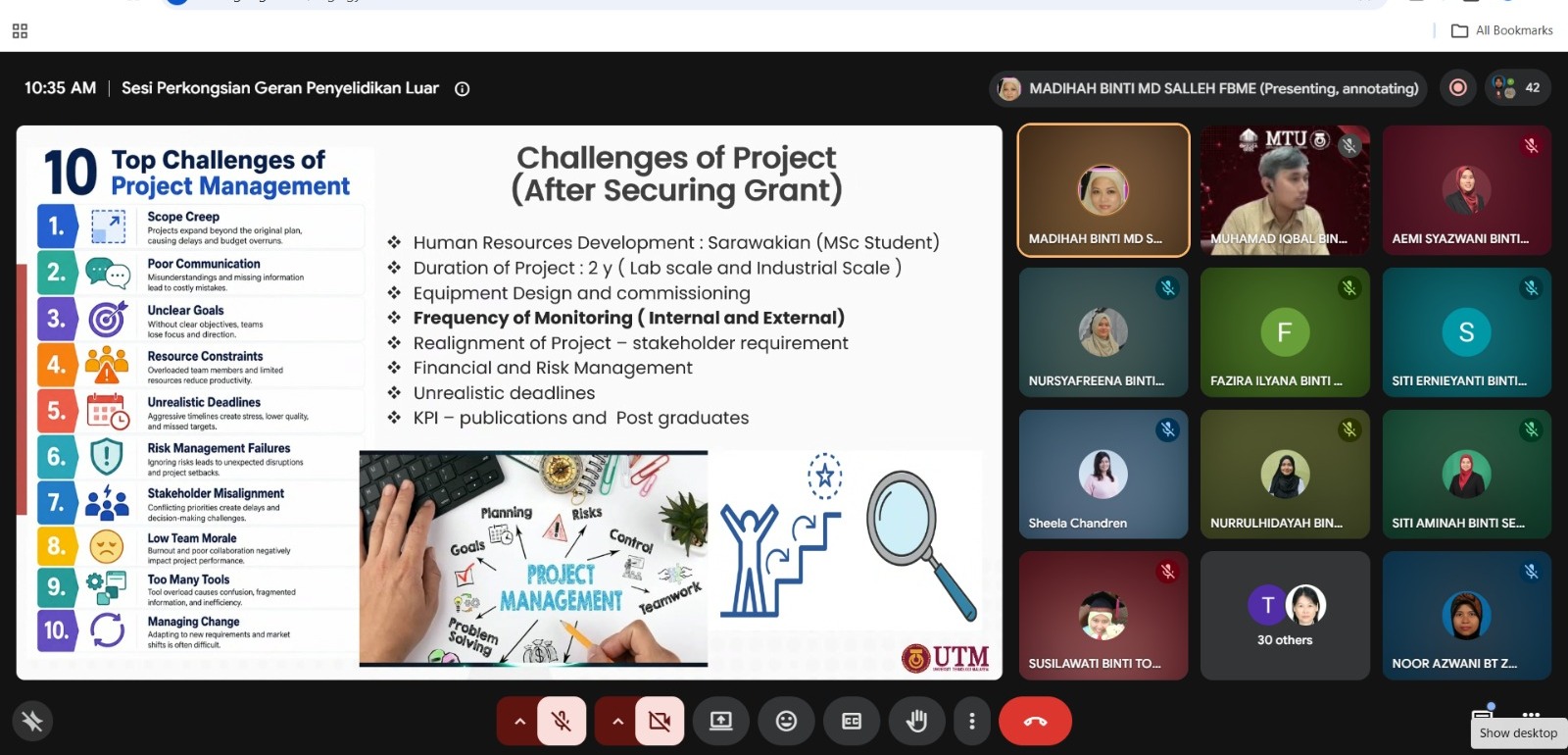
The sharing session further addressed the challenges involved in securing and managing an external research grant. These include finding suitable collaborators, gaining industry trust, demonstrating credible expertise without overclaiming, managing possible reductions in the approved budget, working within short proposal-preparation periods and responding to evaluation panels that may place strong emphasis on economic and stakeholder impact.
The strategy proved successful when the programme received an award under the Sarawak Premier Chair Grant, with RM371,056 in approved funding for the integrated pineapple-waste research programme. The award letter was dated 25 April 2024, with the funded project period indicated as 1 July 2024 to 30 June 2026.
The presentation also demonstrated how successful grant acquisition must be followed by effective project implementation. The biohydrogen sub-project completed its laboratory-scale activities, including inoculum development, optimisation of biohydrogen production and metagenomic analysis, with future work directed towards scale-up. The bromelain project similarly completed its laboratory-scale extraction, purification, characterisation and application studies, with future potential for scale-up and pharmaceutical applications.
Notably, the compost project progressed from laboratory to pilot and industrial scales. The presentation showed the development of an industrial-scale composting process of approximately one tonne at PUSAKA Capital Food Industry in Tanjung Manis, Sarawak, reflecting the translation of university research into a larger-scale application with potential for future commercialisation.
Beyond research outputs, the programme also contributed to human-resource development by involving postgraduate researchers, including students with backgrounds from Universiti Malaysia Sarawak. This demonstrated how externally funded projects can simultaneously support research, industry engagement, capacity building and regional development.
The session reinforced that a successful external grant proposal requires more than a strong scientific idea. Researchers must understand the funder’s priorities, identify genuine stakeholder needs, establish credible partnerships, integrate complementary expertise, demonstrate measurable impact and present a realistic pathway from research activities to outcomes that benefit the intended community or industry.
Through Sharing Session Series 2, Research Month @FS 2026 continues to provide Faculty of Science researchers with practical knowledge and real-world examples to enhance their competitiveness in securing external research funding and translating academic expertise into meaningful societal and industrial impact.
#FSResearchMonth2026
#utmfsresearch