JOHOR BAHRU, 19 August 2026 – The Faculty of Science, Universiti Teknologi Malaysia (UTM), organised Sharing Session Series 2: Intellectual Property – Patent & Copyright Workshop in conjunction with Research Month@FS 2026, providing academics and researchers with practical guidance on protecting research outputs through appropriate intellectual property mechanisms.
Conducted online via Google Meet, the workshop featured Assoc. Prof. ChM. Dr. Lee Siew Ling and Ts. Dr. Siti Pauliena Binti Mohd Bohari, who shared fundamental concepts, practical filing procedures and hands-on guidance related to patents, utility innovations and copyright.
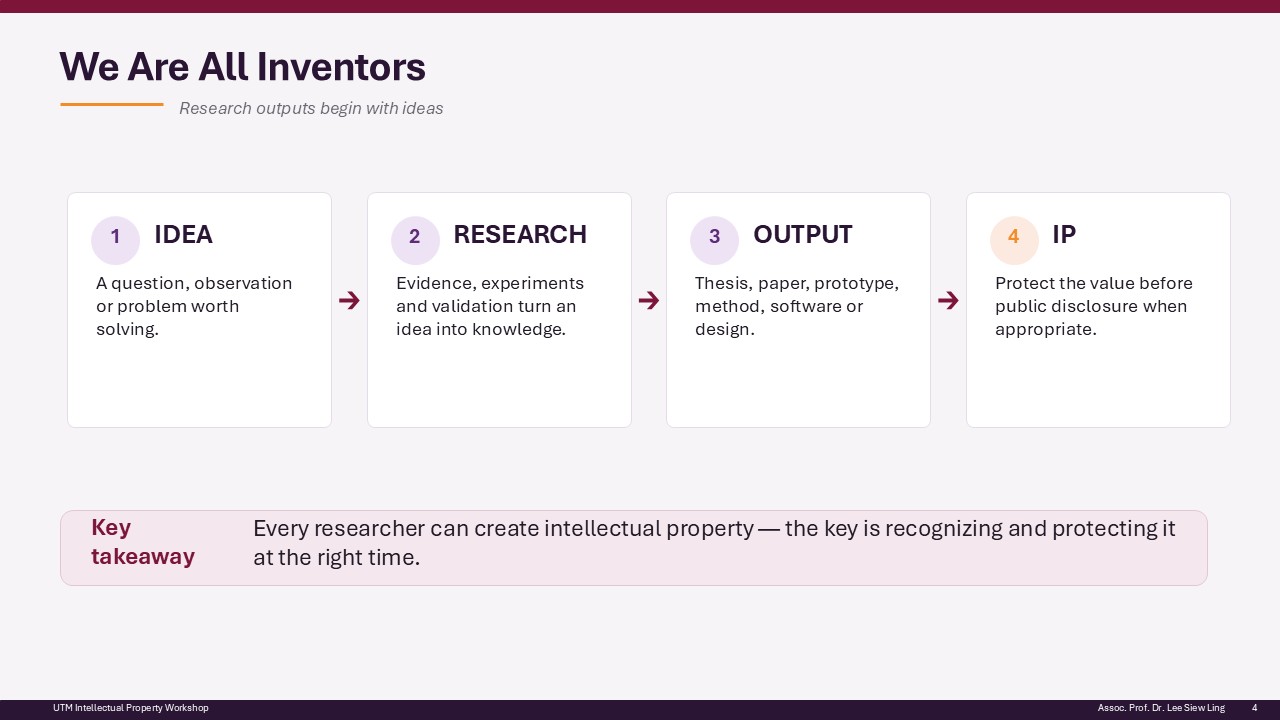
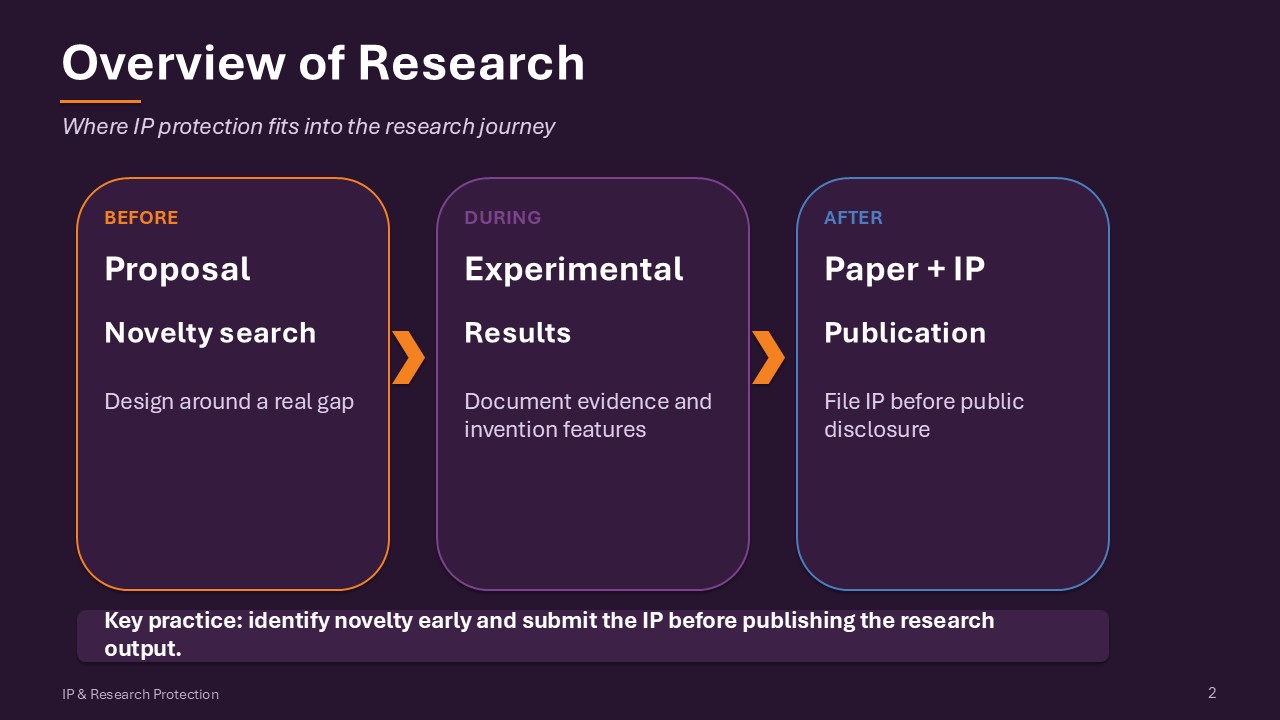
A central message of the workshop was that intellectual property protection should be considered early in the research process. Researchers were encouraged to identify potential novelty during the proposal stage, document evidence and inventive features during experimentation, and consider filing suitable intellectual property protection before public disclosure or publication.
Assoc. Prof. Dr. Lee introduced participants to the different forms of intellectual property relevant to research, including patents, utility innovations, copyrights, trademarks, industrial designs and integrated-circuit layout designs. The session highlighted that different types of research outputs require different protection strategies. For instance, a technical invention may be suitable for patent or utility innovation protection, while original written works, software, reports, illustrations and other creative expressions may fall under copyright.
Particular attention was given to the requirements for patentability. Participants were reminded that a patentable invention must generally demonstrate novelty, an inventive step and industrial applicability. The workshop also clarified the distinction between a patent and utility innovation, with patents protecting new technical solutions and utility innovations providing protection for useful improvements that may not satisfy the same level of inventiveness required for a patent.
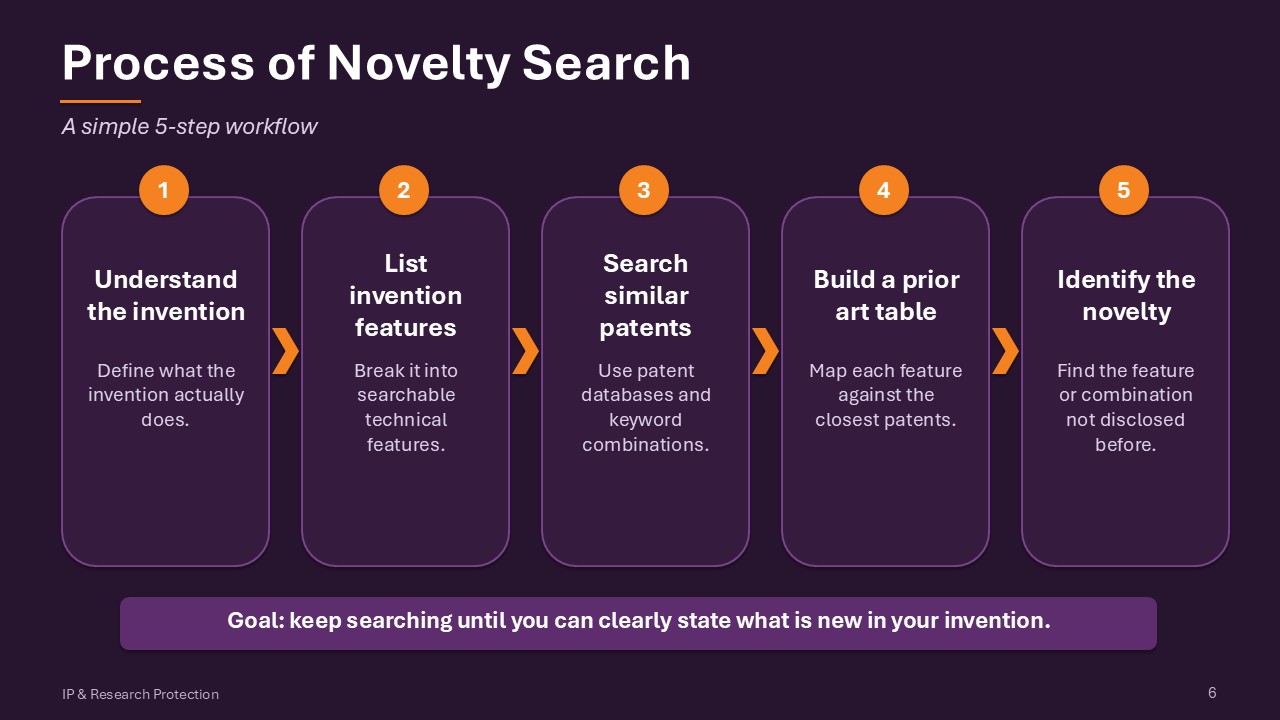
The importance of conducting a novelty or prior-art search was also emphasised. Researchers were guided through a systematic process of defining the invention, identifying its technical features, searching for similar patents, constructing a prior-art comparison table and determining which feature or combination of features represents the novelty of the invention. Patent databases such as Google Patents, Espacenet, USPTO and WIPO PATENTSCOPE were highlighted as useful resources for this purpose.
A practical example involving a silver-loaded zeolite/layered double hydroxide nanocomposite demonstrated how a prior-art table can be used to compare existing patents against specific invention features. Through this approach, researchers can better identify what is genuinely new, refine their research direction and prepare stronger intellectual property applications.
The workshop also introduced participants to the UTM intellectual property application process and the preparation required before filing through INNOCOMMS. Researchers were guided on preparing a clear title, a concise brief description or field of art, and a comprehensive full description or specification of the invention. The full technical description should cover the background or technical problem, preparation or embodiment, key invention features, advantages, supporting figures or data where relevant, and a clear distinction from prior art.
Assoc. Prof. Dr. Lee further demonstrated how to navigate INNOCOMMS, including the submission of contributor information, prior-art details, disclosure information, funding sources, external collaborations, benefits of the invention and other required elements. Participants were reminded that contributor percentages should be properly declared and that related research grants should be included to ensure accurate documentation of research outputs.
Complementing the patent-focused session, Ts. Dr. Siti Pauliena Mohd Bohari provided practical guidance on copyright protection and copyright filing through INNOCOMMS. The session explained that copyright protects the expression of an idea rather than the underlying idea itself and can apply to literary works, artistic works, software, databases, technical drawings, audiovisual materials and other original creative outputs.
Participants were also introduced to the structure of a copyright submission, including preparation of the title, executive summary or brief description, problem statement, full description, conclusion and references. The session highlighted that a single research project may generate several forms of intellectual property, depending on the nature of the outputs produced.
Another important message was the relationship between intellectual property protection and publication. Participants were encouraged to consider intellectual property filing before publicly disclosing potentially patentable research findings. This helps preserve the novelty of an invention while allowing researchers to subsequently publish their work with greater confidence.
The workshop also linked intellectual property protection with commercialisation and research impact. Protected intellectual property can support technology transfer, licensing, commercialisation, industry collaboration and the creation of longer-term value from university research. The session further illustrated several modes of commercialisation, including product sales, spin-off companies, IP licensing and outright sale.
Through Sharing Session Series 2, Research Month@FS 2026 provided researchers with both the conceptual understanding and practical knowledge needed to recognise, document and protect valuable research outputs.
The programme reinforces the Faculty of Science’s commitment to encouraging researchers to move beyond publication alone by identifying the potential intellectual property embedded within their research and protecting that value appropriately before pursuing wider dissemination, collaboration and commercialisation.
#FSResearchMonth2026
#utmfsresearch
#IntellectualProperty
#Patent
#Copyright
#ResearchInnovation