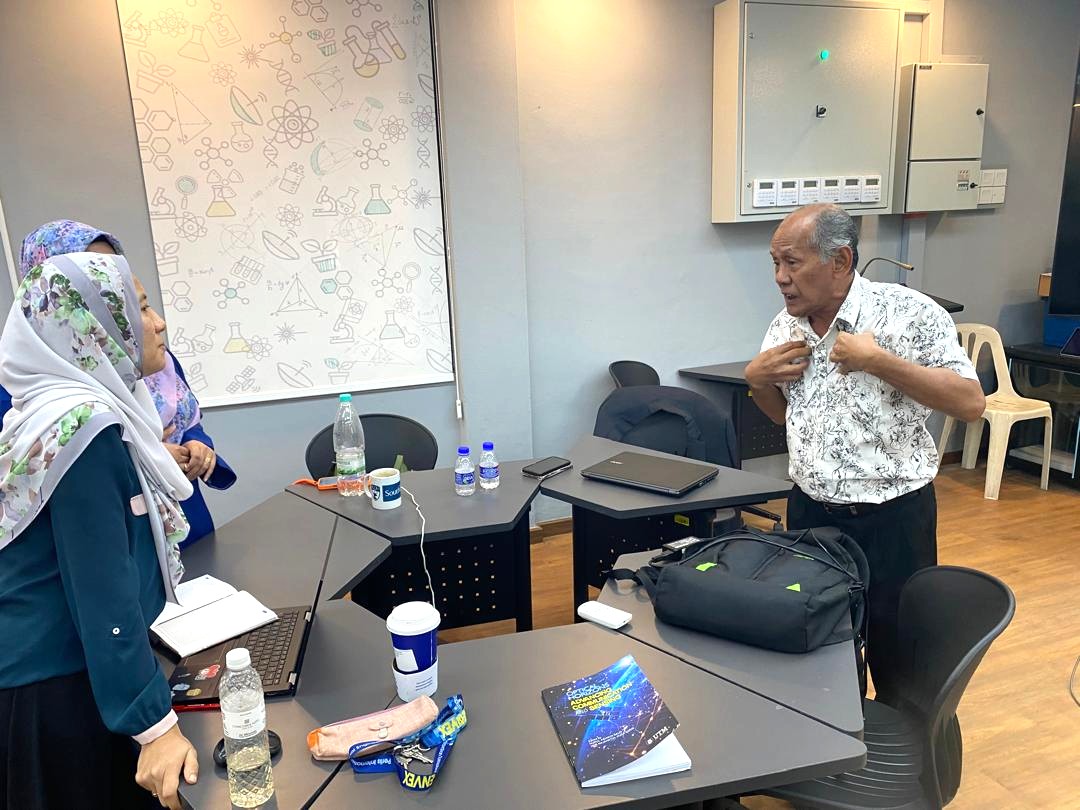
JOHOR BAHRU, 2 September 2026 – The Faculty of Science, Universiti Teknologi Malaysia (UTM), organised Book Workshop Series 2: Research Book Writing Workshop in conjunction with Research Month@FS 2026, providing academics and researchers with practical guidance on transforming research outputs into high-quality scholarly books.
Held at Bilik HELIX, C17, Faculty of Science, the workshop featured Prof. Dr. Rosli Hussin, who shared his experience and perspectives on research book writing, manuscript development, scholarly communication and the expectations of academic publishers and book evaluators.
A key focus of the workshop was understanding the fundamental differences between a research book, thesis and journal article. While theses and journal papers are typically written for specialised academic audiences and emphasise methodology, results and technical detail, a research book should be structured for a broader readership and present knowledge in a more accessible, coherent and engaging form.
Prof. Dr. Rosli emphasised that converting a thesis into a research book should not simply involve reproducing the thesis in book format. Instead, authors need to transform the writing style, restructure the chapters, reduce overly technical sections and develop a more narrative and critical approach. The focus should move beyond presenting raw findings towards explaining their theoretical significance, implications and wider contribution to the field.
The workshop also highlighted three important objectives of research books: translating complex research into broader understanding, providing a reference for postgraduate students and emerging researchers, and connecting laboratory or academic findings with real-world challenges.
Participants were introduced to several recurring challenges in academic book publishing, including limited writing time, insufficient experience in book-style scholarly writing, weak organisation of ideas, inconsistent manuscript quality, excessive technical language, poorly prepared figures and tables, incomplete references and a lack of clear alignment between the title, scope and intended audience.
Particular attention was given to the quality of a research book. A strong scholarly book should have a clear purpose and scope, a well-defined target readership, logical chapter progression, consistent terminology, appropriate language, strong academic content and effective use of illustrations, tables and references. The workshop also stressed the importance of introductory and concluding components such as the preface, synopsis, references, glossary and index.
Another important aspect was the transition from thesis-style language to research-book language. Thesis writing is generally objective, dense and technically specific, often relying heavily on passive constructions and frequent citations. In contrast, research-book writing should remain scholarly while becoming more narrative, explanatory and reader-friendly. Authors were encouraged to use active sentences where appropriate, provide context before introducing complex concepts and guide readers progressively from fundamental ideas to more advanced discussions.
The session also explored the appropriate use of technical jargon. While specialised terminology can improve precision and efficiency among experts, excessive jargon may reduce accessibility. Researchers were encouraged to define unavoidable technical terms, use analogies or examples where appropriate and adjust the level of terminology according to the intended readership.
A major practical component of the workshop addressed how researchers can transform raw data into meaningful knowledge. Prof. Dr. Rosli introduced the Data–Information–Knowledge–Wisdom (DIKW) framework, which encourages authors to move progressively from simply presenting numerical data to providing context, interpretation, scientific understanding and, ultimately, meaningful implications or recommendations.
Under this approach, tables and figures should not merely reproduce raw data from a thesis. Authors should explain the patterns, highlight meaningful trends, interpret their significance and connect the findings with the wider scientific or societal context. Visual elements should be accompanied by clear titles, explanations and conclusions so that readers understand what the data mean rather than being expected to interpret them independently.
The workshop further discussed the role of references in research books. Although scholarly books still require credible sources, their use can be more balanced than in a thesis or journal article. Authors were encouraged to prioritise significant references, maintain readability and use authoritative narrative writing while ensuring that key technical statements remain academically supported.
The relevance of research books in the age of artificial intelligence was also addressed. Despite the rapid availability of information through digital platforms and AI tools, scholarly books remain important because they provide structured knowledge, in-depth interpretation, original perspectives, intellectual credibility and long-term academic value. AI may assist with drafting, organisation and language improvement, but it does not replace the author’s expertise, critical thinking and intellectual contribution.
One of the strongest messages from the workshop was that a research book should not feel like a copied thesis; it should become a mature form of knowledge storytelling, written for readers who want to understand the subject rather than merely examine research results.
Through Book Workshop Series 2, Research Month@FS 2026 provided Faculty of Science researchers with practical strategies to transform theses, journal publications and research reports into scholarly books that are clearer, more engaging and more meaningful to wider audiences.
The programme reflects the Faculty of Science’s continuing commitment to strengthening academic writing, scholarly publishing and the long-term dissemination of research knowledge through authoritative and accessible research books.
#FSResearchMonth2026
#utmfsresearch
#ResearchBookWriting
#AcademicPublishing
#ScholarlyWriting
#UTMFacultyofScience