
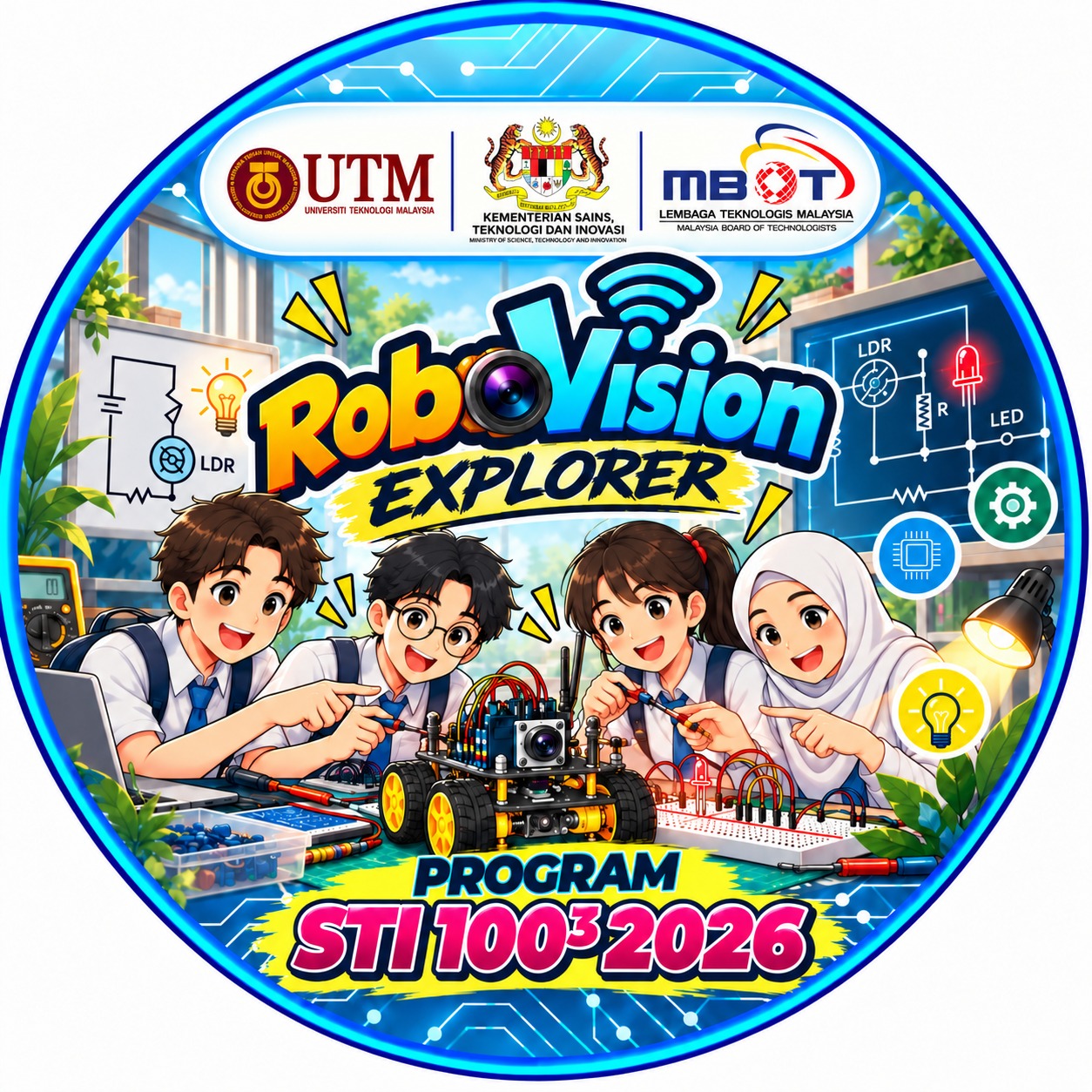
RoboVision Explorer: Discover Physics, Explore Robotics, Inspire Innovation
Transforming Fundamental Physics into Smart Technology Through Community Knowledge Transfer
RoboVision Explorer is an innovative Science, Technology, Engineering and Mathematics (STEM) knowledge-transfer programme that connects fundamental physics, basic electronics and smart robotics through interactive, hands-on learning experiences.
Developed by the Department of Physics, Faculty of Science, Universiti Teknologi Malaysia (UTM), in collaboration with the Centre for Sustainable Nanomaterials (CSNano), Ibnu Sina Institute for Scientific and Industrial Research (ISI-SIR), this initiative forms part of Program STI 100³ MOSTI 2026.
The programme brings together university academics, researchers, undergraduate students, school teachers and secondary-school learners to explore how scientific principles can be transformed into real-world technological applications.
Its central philosophy is simple:
Learn the Science → Understand the Technology → Apply the Knowledge → Inspire Others
By integrating physics education with experiential learning and community engagement, RoboVision Explorer aims to nurture scientific curiosity, technological literacy, creativity and problem-solving skills among young learners.
1. The RoboVision Explorer Experience
From Light-Sensitive Circuits to Intelligent Robotic Systems
How does a robot sense its environment? How can light control an electronic device? What makes a robot move, capture images and communicate wirelessly?
These questions form the foundation of RoboVision Explorer.
The programme introduces participants to the fascinating relationship between physical phenomena, electronic systems and robotic technologies through two progressive learning phases.
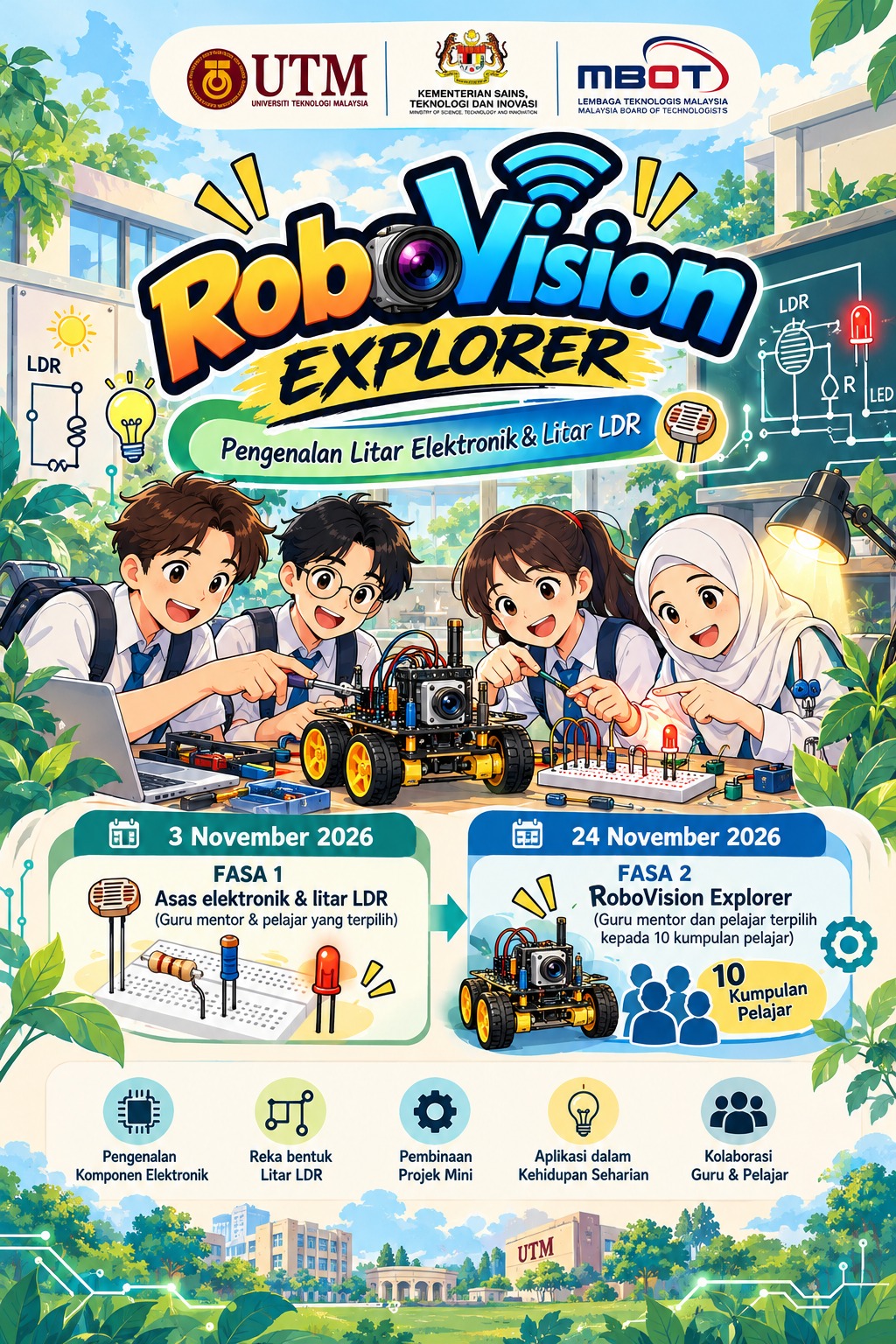
Phase 1 | Explore the Fundamentals: Basic Electronics and LDR Circuits
3 November 2026
Participants begin their journey by discovering how fundamental physics principles operate within simple electronic circuits.
Through practical demonstrations and guided activities, selected school teachers and students explore:
-
Basic electronic components, including resistors, LEDs, power sources and light-dependent resistors (LDRs).
-
Fundamental electrical concepts such as current, voltage, resistance and energy conversion.
-
The relationship between light intensity and electrical resistance.
-
The development of simple light-responsive electronic circuits.
The highlight of this phase is the LDR circuit, where participants discover how light can be detected and converted into an electrical response.
Key learning experience: Turning light into an electrical signal.
Phase 2 | Explore the Innovation: Smart Robotics and RoboVision
24 November 2026
Building upon the knowledge acquired in Phase 1, participants progress towards exploring a WiFi- and camera-enabled robotic platform.
Through demonstrations, interactive challenges and group activities, students investigate how multiple scientific principles work together within an integrated robotic system.
Key learning areas include:
-
Electronic circuits and embedded control systems.
-
Robotic movement and the physics of mechanics.
-
Camera technology and image acquisition.
-
Wireless communication and remote operation.
-
Integration of sensors, motors and electronic components.
Mentor teachers and selected students will subsequently transfer their knowledge to ten groups of secondary-school learners, expanding the programme’s educational reach.
Key learning experience: Connecting physics, electronics and wireless technology to create a functioning robotic system.
2. Physics Beyond the Classroom
Connecting Scientific Principles with Everyday Technology
RoboVision Explorer demonstrates that physics is not merely a collection of equations and theories. It provides the scientific foundation for many technologies used in modern society.
The programme connects fundamental concepts with practical applications:
| Physics concept | Technology application |
|---|---|
| Electricity and resistance | Basic electronic circuits |
| Optics and light interaction | LDR sensors and camera systems |
| Mechanics and motion | Robotic movement and motor control |
| Electromagnetism | Electrical motors and wireless systems |
| Energy conversion | Electronic and robotic operations |
| Signals and communication | WiFi-enabled remote robotics |
By recognising these connections, students gain a deeper appreciation of how scientific knowledge contributes to technological advancement.
The goal is not simply to operate a robot, but to understand the science that makes robotics possible.
3. Empowering University Students as STEM Facilitators
From Learning Physics to Teaching Physics
A distinctive component of RoboVision Explorer is the involvement of first-year students pursuing the Bachelor of Science (Industrial Physics) with Honours, particularly those enrolled in SSCP1102 Introduction to Physics.
The programme provides a platform for students to translate classroom learning into real-world educational experiences.
As STEM facilitators, UTM students are encouraged to explain scientific principles in accessible ways, guide hands-on activities and communicate the relevance of physics to younger learners.
This experiential approach strengthens both technical and transferable skills, including:
-
Scientific competency: Applying fundamental physics to real technological systems.
-
Communication: Explaining complex scientific ideas clearly and effectively.
-
Leadership and teamwork: Facilitating collaborative learning activities.
-
Creativity and problem-solving: Developing engaging demonstrations and addressing practical challenges.
-
Social responsibility: Contributing scientific knowledge and expertise to the wider community.
Through this initiative, undergraduate students become more than recipients of knowledge. They become STEM ambassadors who connect university education with community development.
4. Knowledge Transfer That Creates Lasting Impact
Building a Community of STEM Educators and Learners
RoboVision Explorer adopts a multilevel knowledge-transfer model designed to extend learning beyond a single outreach activity.
UTM Academics and Researchers → Undergraduate STEM Facilitators → Mentor Teachers and School Student Leaders → Wider School Community
This approach enables knowledge to be progressively shared, reinforced and applied across different learning groups.
By developing the capabilities of teachers and selected school students, the programme seeks to establish a more sustainable foundation for continued STEM engagement.
The programme also incorporates learning evaluation through demonstrations, short quizzes, practical activities, participant observations and feedback.
These activities help assess participants’ understanding, identify areas for improvement and support the future refinement of STEM learning modules.
The intended impact extends beyond acquiring technical knowledge. RoboVision Explorer aims to build confidence, encourage scientific exploration and inspire participants to continue learning independently.
5. Academic Expertise and Collaborative Innovation
RoboVision Explorer is supported by a multidisciplinary academic and technical task force established through CSNano, ISI-SIR.
The programme is led by Dr. Siti Salwa Alias, with support from:
-
Assoc. Prof. Dr. Abd. Khamim Ismail
-
Dr. Muhammad Firdaus Omar
-
Dr. Razif Razali
-
Dr. Faizani Mohd Noor
-
Dr. Izyan Hazwani Hashim
-
Dr. Suhaila M. Buhari
-
Dr. Norshahirah Mohamad Saidi
-
Dr. Nurhafizah Hasim
Together with the programme’s technical and supporting personnel, the team contributes expertise in physics, electronics, science education, technological applications and community engagement.
The programme targets secondary-school students at SMK Dato’ Usman Awang, Johor Bahru, establishing an educational partnership that connects university resources and expertise with school-based STEM learning.
6. Supporting UTM ASCEND 2030
Translating University Excellence into Societal Value
RoboVision Explorer reflects UTM’s aspiration to develop future-ready talent while creating meaningful benefits for society through education, research, innovation and community partnerships.
The initiative supports key dimensions of UTM ASCEND 2030:
Humanity & Well-being
Empowering school communities through accessible science education, technological exposure and strategic knowledge transfer.
Global Talent
Developing university students’ leadership, scientific communication, teamwork and problem-solving capabilities through authentic community engagement.
Leap in Niche Excellence
Connecting fundamental scientific knowledge with emerging technologies, including embedded electronics, wireless communication and smart robotics.
The programme also embraces UTM’s Integrity, Synergy, Excellence and Sustainability (ISES) values through responsible scientific practice, multidisciplinary collaboration, quality learning experiences and sustainable knowledge sharing.
7. Advancing the Sustainable Development Goals
RoboVision Explorer contributes to global sustainability through education, innovation and collaborative partnerships.
SDG 4 – Quality Education
Promoting accessible, engaging and experiential STEM education for secondary-school learners.
SDG 9 – Industry, Innovation and Infrastructure
Introducing the fundamentals of electronics, robotics and technology-based innovation to future generations.
SDG 17 – Partnerships for the Goals
Strengthening collaboration among universities, schools and national science and technology initiatives.
By aligning scientific education with community empowerment, RoboVision Explorer demonstrates how academic initiatives can contribute to long-term societal development.
8. More Than Robotics: Inspiring the Next Generation
RoboVision Explorer is built upon the belief that every young learner has the potential to become a scientist, engineer, technologist or innovator.
A simple electronic circuit can introduce the principles of electricity. A light-sensitive sensor can demonstrate the interaction between physics and technology. A camera-enabled robot can reveal how multiple scientific concepts are integrated into a functional system.
Most importantly, these experiences can inspire curiosity and encourage young minds to ask questions, experiment and explore new possibilities.
By bringing together university researchers, academics, undergraduate students, school teachers and secondary-school learners, RoboVision Explorer creates a meaningful bridge between scientific knowledge and community empowerment.
The ultimate achievement is not merely a functioning robot, but a generation of learners who understand science, embrace technology and possess the confidence to innovate.
RoboVision Explorer at a Glance
| Component | Details |
|---|---|
| Programme | RoboVision Explorer |
| Focus | Basic Electronics, Physics and Smart Robotics |
| Initiative | Program STI 100³ MOSTI 2026 |
| Organisers | Department of Physics, Faculty of Science UTM; CSNano, ISI-SIR |
| School partner | SMK Dato’ Usman Awang, Johor Bahru |
| Phase 1 | 3 November 2026 – Basic Electronics and LDR Circuits |
| Phase 2 | 24 November 2026 – Smart Robotics and Knowledge Transfer |
| Target participants | Secondary-school students (Forms 1–4) |
| University involvement | First-year Industrial Physics undergraduates (SSCP1102) |
| Programme Leader | Dr. Siti Salwa Alias |
| Strategic alignment | UTM ASCEND 2030, UTM ISES, SDG 4, SDG 9 and SDG 17 |
Discover Physics. Explore Robotics. Inspire Innovation.
Connecting scientific knowledge, technological creativity and community empowerment through experiential STEM education.
